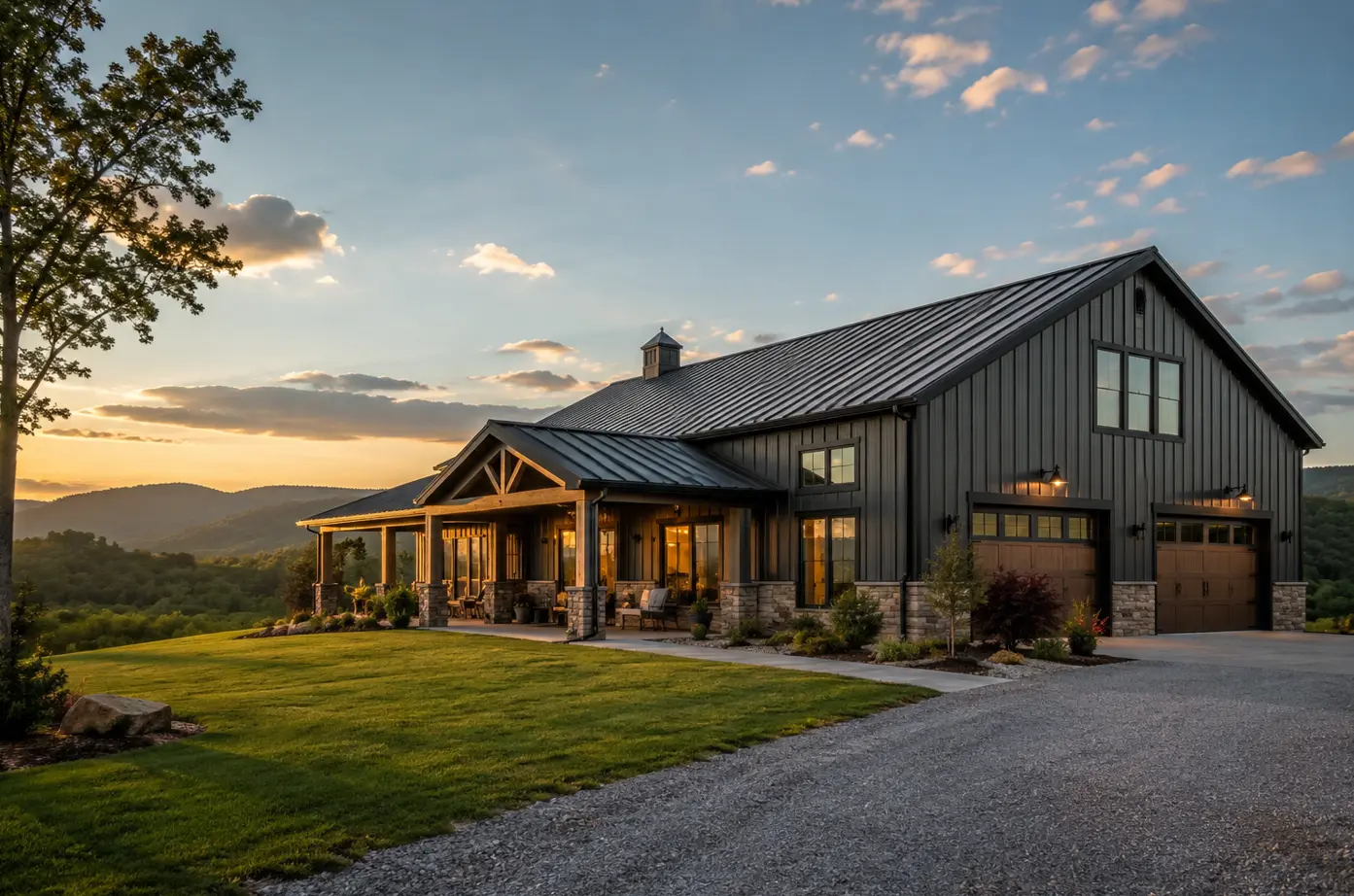
A barndominium built in Tennessee is not engineered the same way as one built in Texas, Florida, or Colorado. The state’s mix of humid subtropical summers, winter ice events, county-by-county permitting, and a seismic zone in the west all shape how these homes are designed and constructed. Buyers who assume a generic barndominium kit will perform the same way everywhere often run into costly surprises once construction begins. This guide breaks down the climate, code, soil, and regional factors that set Tennessee barndominium construction apart, so you know exactly what to expect before you build.
Why Tennessee Is a Distinct State for Barndominium Construction
Barndominiums first gained traction in states like Texas, where flat terrain, dry conditions, and looser rural zoning made steel-frame homes simple to permit and build. Tennessee shares some of that rural flexibility, but the similarities largely end there. The state’s geography stretches from the Mississippi River floodplain in the west to the Appalachian foothills in the east, creating construction conditions that shift dramatically depending on where in the state you build.
This geographic range means a barndominium engineered for Memphis will not meet the same requirements as one built outside Knoxville. Builders who work across multiple states sometimes apply a one-size-fits-all approach to design, which is where problems start. Understanding the variables unique to Tennessee, climate, seismic risk, soil, and local permitting, is the first step toward a build that holds up over time.
Climate Differences That Affect Tennessee Barndominium Construction
Tennessee’s climate is one of the biggest factors separating it from other barndominium-heavy states. Most of the state experiences a humid subtropical climate, with hot, humid summers, cold snaps and occasional ice storms in winter, and a distinct severe weather season in spring and fall. This cycling between heat and cold, wet and dry, puts more stress on building materials than a climate that stays consistently hot or consistently cold.
- Freeze-thaw cycling: Wood framing absorbs moisture during humid summers and contracts as temperatures drop in winter, which can loosen fasteners and open gaps over multiple seasons.
- Humidity management: Tennessee’s summer humidity makes proper ventilation, vapor barriers, and moisture-resistant materials more important than in drier climates like West Texas or Arizona.
- Ice storm exposure: Winter ice adds weight to rooflines and can create ice dams at eaves and valleys, which is a different concern than the snow load calculations used in northern states.
- Elevation-driven weather: East Tennessee’s mountain foothills see colder temperatures, more precipitation, and occasional heavy wet snow that flatland counties in the same state never experience.
By comparison, a barndominium built in a drier, more consistently hot state faces fewer of these cycling stresses. That difference shows up in material selection, underlayment choices, and how a metal building company in Tennessee specifies roofing and wall assemblies for long-term durability.
Tornado Risk and Wind Load Requirements in Tennessee
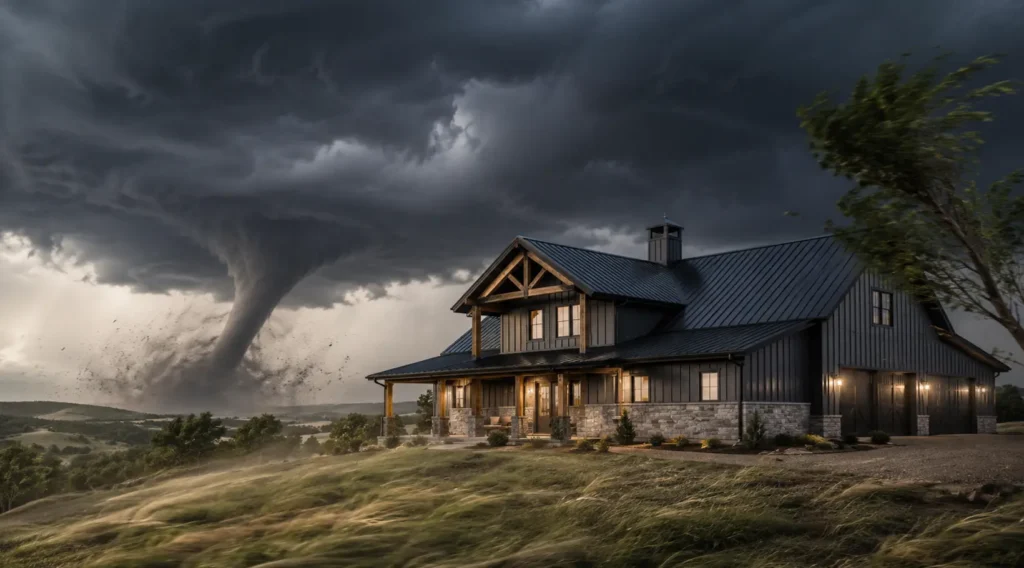
Tennessee sits within a recognized tornado corridor, particularly across Middle Tennessee and West Tennessee. This is a meaningfully different risk profile than coastal states dealing with hurricanes or western states managing wildfire exposure. Tennessee’s adopted building code sets design wind speeds in the range of 110 to 115 mph statewide, with engineering requirements that account for both straight-line wind events and tornado-related gusts.
Wind load design affects several structural decisions on a barndominium:
- Anchoring and hold-down systems at the foundation
- Frame connection details between the steel structure and roof system
- Exposure category, which changes based on whether the site is open rural land or sheltered by trees and terrain
- Storm shelter or safe room provisions, which many Tennessee buyers consider during the design phase even when not legally required
A barndominium engineered for a lower wind speed state will not automatically meet Tennessee’s requirements. This is one reason working with Tennessee barndominium contractors who already understand the state’s wind design standards matters more than it might in a state with a single, simpler code requirement.
Seismic Considerations Unique to West Tennessee
Few buyers researching barndominiums expect earthquake engineering to be part of the conversation, but it is a real factor in parts of Tennessee. The New Madrid Seismic Zone runs through the western part of the state, and counties in that region carry a higher seismic design category than the rest of Tennessee.
What this means in practical terms:
- East Tennessee counties typically fall into Seismic Design Category B, the lowest level of concern
- Middle Tennessee counties often fall into Category B or C
- West Tennessee counties near the New Madrid Fault Zone can fall into Category C or D1, which requires more rigorous lateral bracing and foundation anchoring
This seismic variation within a single state is unusual. Most states that are popular for barndominium construction, including Texas and much of the Southeast, do not have a comparable earthquake risk zone running through part of their territory. A builder unfamiliar with this distinction may underdesign a West Tennessee structure if they are used to working in states where seismic load is not a meaningful design factor.
Have a building-related question for Tennessee?
Soil Conditions and Foundation Engineering Across the State
Tennessee’s soil composition changes significantly from region to region, which directly affects foundation design. Middle Tennessee is known for clay-heavy soils that expand and contract seasonally as moisture levels change. This movement can stress a foundation if it is not engineered to account for it. West Tennessee, closer to the Mississippi River, often deals with different alluvial soil conditions, while parts of East Tennessee sit on more stable, rocky terrain with limestone bearing capacity that supports straightforward slab-on-grade construction.
Soil testing before foundation design is standard practice for a serious build, and the results often determine which foundation type makes sense:
- Standard slab-on-grade, suited to stable, well-draining soil
- Engineered or reinforced slab, used where clay soils require additional structural consideration
- Pier and beam or crawlspace foundations, sometimes used on sloped or uneven terrain common in East Tennessee’s foothills
This is a sharp contrast to states with more uniform soil conditions across their barndominium-building regions, where a single foundation approach can often be reused project after project. In Tennessee, the right foundation depends heavily on which part of the state, and even which county, the home sits in.
County-by-County Permitting and Zoning Variation
One of the most distinctive features of Tennessee barndominium construction is how much permitting requirements shift from one county to the next. Tennessee does not enforce a single statewide building permit process the way some states do. Instead, requirements are set at the county and, in some cases, city level.
This creates a wide range of outcomes:
- Some rural counties have opted out of mandatory residential inspections entirely, simplifying the permitting timeline
- Other counties require permits and inspections for all structures, including accessory buildings, with no exceptions for agricultural use
- Stamped engineering drawings are required in most jurisdictions for residential structures, though the threshold for when stamped prints are needed varies by county
- Counties near major metro areas, including those surrounding Nashville, Knoxville, Memphis, and Chattanooga, typically apply stricter zoning, setback requirements, and architectural review than rural counties farther out
Tennessee jurisdictions generally enforce the International Residential Code, though the specific edition adopted (2012, 2015, or 2018) can differ depending on when the local government last updated its code. This matters because each edition carries slightly different structural and energy requirements. Barndominium builders in Tennessee that work across multiple counties needs to track these differences project by project, since what passes inspection in one county may require additional documentation in the next.
This is meaningfully different from states with a single statewide code authority, where the permitting process looks largely the same no matter where in the state you build. In Tennessee, the county you choose can affect your timeline as much as the design of the home itself.
Learn everything about city vs county vs rural building requirements in Tennessee.
Rural Versus Urban Construction Realities in Tennessee
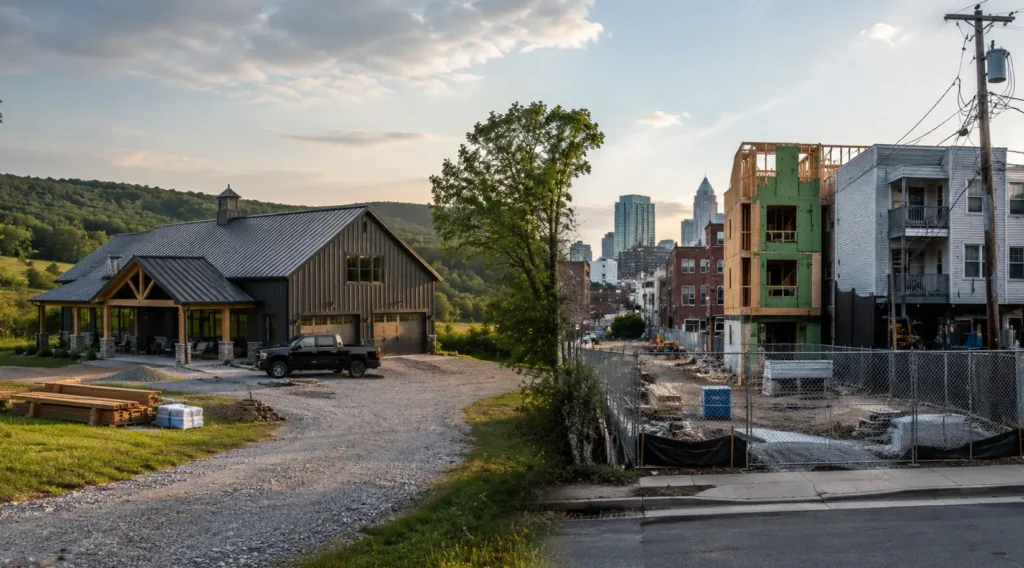
Tennessee’s mix of dense urban corridors and wide-open rural counties creates two very different construction experiences within the same state. Rural counties, particularly in parts of Middle and West Tennessee, often have minimal zoning restrictions and more straightforward permitting, which is part of why barndominiums have grown popular here. Land is more affordable, lot sizes are larger, and there is generally more flexibility in exterior design.
Closer to Nashville, Knoxville, Memphis, and Chattanooga, the picture changes:
- Stricter architectural standards may apply, sometimes requiring stone, brick, or board-and-batten accents rather than an all-metal exterior
- Setback and height requirements are more commonly enforced
- HOA covenants in some subdivisions specifically prohibit metal-sided structures, even where county zoning would otherwise allow them
- Permit review timelines tend to run longer due to higher application volume
Buyers comparing land should review any deed restrictions or HOA covenants before purchasing, since not all rural-feeling parcels are free of these limitations. Working with a team experienced in land selection and site evaluation support in Tennessee before signing on a property can prevent a buyer from purchasing land that later turns out to be unsuitable for the design they have in mind. See our land selection checklist before you spend money on any land, regardless of how attractive the offer is.
How Tennessee Compares to Other Popular Barndominium States
Texas remains the state most associated with barndominium construction, and it shares some traits with Tennessee, including large rural counties with flexible zoning and a strong culture around metal-frame buildings. The differences become clear once you look past the surface similarities.
- Climate: Texas spans arid west Texas conditions to humid east Texas heat, with extreme summer temperatures and hurricane exposure along the Gulf Coast. Tennessee’s climate is more uniformly humid subtropical, with a true four-season cycle that includes winter ice events Texas rarely sees outside its panhandle.
- Wind and storm risk: Texas faces hurricane risk along the coast in addition to tornado activity inland. Tennessee’s primary wind risk is tornado activity, concentrated in Middle and West Tennessee, without the coastal hurricane factor.
- Seismic risk: Few Texas regions carry meaningful seismic design requirements for residential barndominium construction. West Tennessee’s proximity to the New Madrid Seismic Zone makes this a real factor that does not exist in most other barndominium-popular states.
- Soil conditions: Texas is known for expansive clay soils in many regions, requiring engineered foundations. Tennessee has its own clay-heavy zones in Middle Tennessee, but also includes the more stable limestone terrain of East Tennessee and the alluvial soils near the Mississippi River in the west, a wider range within one state.
- Permitting structure: Both states delegate much of the permitting authority to the county level, but Tennessee’s mix of opted-out rural counties and stricter metro counties creates a sharper contrast within shorter driving distances.
States farther north, such as those with heavier snow load requirements, or coastal states with hurricane-grade wind design, present an entirely different engineering profile than Tennessee. The takeaway for buyers is that experience building barndominiums in one state does not automatically transfer to building one correctly in another. Tennessee’s specific combination of climate, seismic, soil, and permitting factors needs to be addressed directly.
Read our complete guide on building a barndominium in Tennessee.
Common Misconceptions About Building a Barndominium in Tennessee
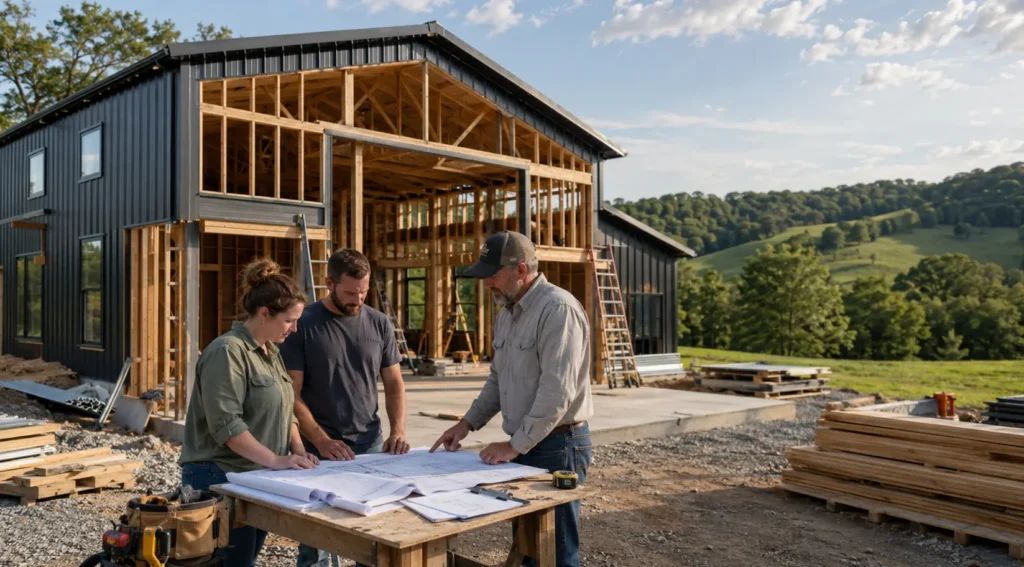
Several assumptions trip up buyers who are new to barndominium construction in this state. Clearing these up early avoids delays and unexpected costs later in the project.
- “Tennessee has no building codes for barndominiums.” Zoning and inspection requirements vary by county, but the structure still has to meet wind, structural, and electrical code requirements regardless of how relaxed local zoning may be.
- “Rural land means no restrictions at all.” Rural counties often have fewer zoning restrictions, but deed restrictions, HOA covenants, and floodplain regulations can still apply even on agricultural-zoned land.
- “A kit designed for another state will work fine here.” Wind load, seismic category, and snow load requirements are location-specific, and a kit engineered for a different state will not automatically meet Tennessee’s structural requirements.
- “Permits work the same everywhere in the state.” County-level variation in Tennessee is significant. What is true for one county may not apply thirty minutes down the road.
- “Metal buildings can’t meet residential energy codes.” With proper insulation, vapor barriers, and HVAC design, steel-frame barndominiums can meet the same energy code requirements as traditional stick-built homes in Tennessee.
Practical Considerations Before You Build in Tennessee
Buyers who plan ahead for these state-specific factors tend to have a smoother build process. Choosing a custom home builders in Tennessee with documented experience in your specific county, not just general barndominium experience, makes the biggest difference. A few additional practical steps help too:
- Confirm which IRC edition your county has adopted before finalizing engineering drawings
- Request a soil test before committing to a foundation type, especially in clay-heavy Middle Tennessee counties
- Ask whether your land falls within a higher seismic design category if you are building in West Tennessee
- Review HOA covenants and deed restrictions even on rural-feeling parcels near growing metro areas
Reviewing available Barndominium floor plans in Tennessee early in the process also helps buyers understand what configurations are realistic for their land, budget, and the structural requirements specific to their region of the state.
Want to speak to a barndo builder in Tennessee?
Regional Differences Within Tennessee Itself
It is worth emphasizing that Tennessee is not internally uniform. The construction considerations in East Tennessee territory, around cities like Knoxville and Chattanooga with its mountain terrain, elevation-driven snow loads, and rocky soil, differ meaningfully from what applies further west.
Builders working in the central part of the state see different conditions again. Working with barndominium builders in Middle Tennessee is a great move because you have to deal with clay soils and higher tornado exposure that defines the region and cities nearby such as Nashville, Franklin, Murfreesboro and Clarksville.
Out toward the river, barndominium builders in West Tennessee navigate flatter terrain, alluvial soil, and the added seismic design requirements tied to the New Madrid zone and cities like Memphis and Jackson.
This internal variation is part of what makes Tennessee distinct compared to states with more geographically uniform conditions. A builder needs regional knowledge within the state, not just statewide familiarity, to design and construct correctly the first time.
Conclusion
Barndominium construction in Tennessee is shaped by a combination of factors rarely found together in other states: a humid subtropical climate with genuine winter cycling, tornado-driven wind load requirements, a real seismic risk zone in the west, soil conditions that shift from clay to limestone to river alluvium, and a permitting system that varies significantly by county.
None of these factors make building here more difficult than other states, but they do mean a generic, one-size-fits-all approach does not hold up. Buyers who understand these regional differences, and who work with builders who have hands-on experience navigating them, are far better positioned for a durable, code-compliant home built specifically for Tennessee conditions.
Frequently Asked Questions
Do all counties in Tennessee require a building permit for a barndominium?
No. Some rural Tennessee counties have opted out of mandatory residential inspections and require minimal permitting for agricultural-zoned structures. Other counties require permits and inspections for every structure, including accessory buildings. Always confirm requirements with your specific county office before purchasing land or starting design.
What wind speed do Tennessee barndominiums need to be engineered for?
Tennessee’s adopted building code sets design wind speeds in the range of 110 to 115 mph statewide, reflecting the state’s tornado risk, particularly across Middle and West Tennessee. The exact requirement and exposure category depend on your specific site and county.
Is earthquake engineering really necessary for a Tennessee barndominium?
It can be, depending on location. West Tennessee counties near the New Madrid Seismic Zone fall into higher seismic design categories than East or Middle Tennessee, which requires additional foundation anchoring and lateral bracing. A licensed engineer will determine the seismic design category that applies to your parcel.
Can I use the same barndominium kit design in Tennessee that’s popular in Texas?
Not without modification. A kit engineered for a different state’s wind speed, seismic category, or snow load will not automatically meet Tennessee’s structural requirements. The exterior design may look similar, but the engineering behind it needs to match Tennessee-specific conditions.
Does soil type really affect what kind of foundation I need in Tennessee?
Yes. Middle Tennessee’s clay-heavy soils expand and contract with moisture changes, often requiring an engineered or reinforced slab. East Tennessee’s more stable, rocky terrain can support straightforward slab-on-grade construction, while West Tennessee’s alluvial soils near the Mississippi River may call for different foundation considerations. A soil test before foundation design is the only reliable way to know what your specific lot requires.