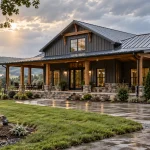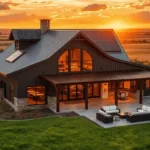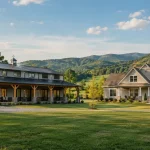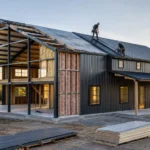
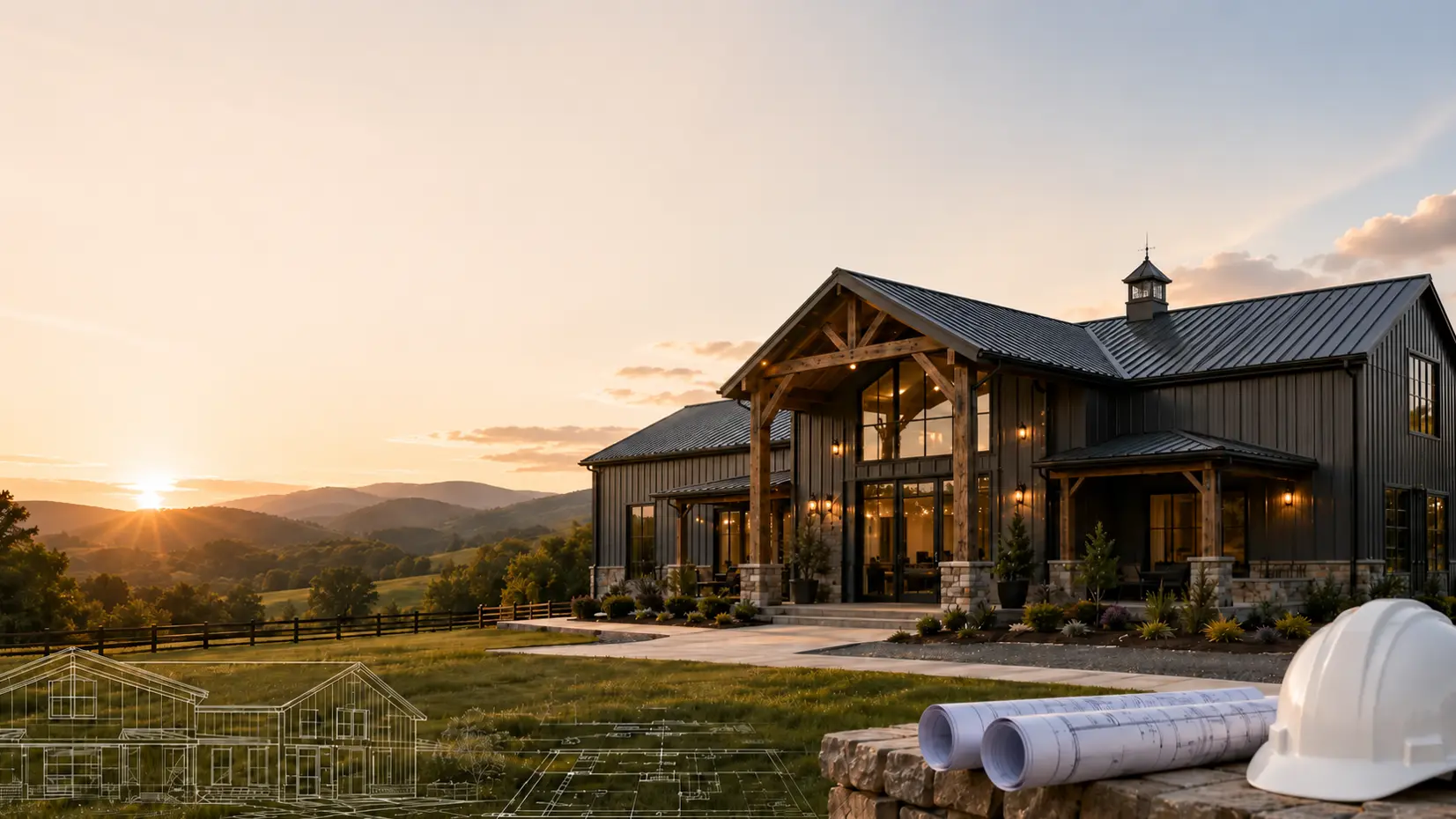
Building a barndominium in Tennessee is not a single decision. It is a sequence of connected ones, each with consequences for cost, timeline, and livability. The process runs from raw land all the way through framing, insulation, mechanical systems, interior finishing, and final inspection. Done well, you end up with a durable, energy-efficient home that outperforms conventional construction on both value and longevity.
Done poorly, mistakes at one stage compound into serious problems at the next. This guide walks through every stage of the process in plain terms, so you know what to expect before the first piece of equipment rolls onto your property.
What Is a Barndominium, and Why Tennessee?
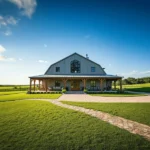
A barndominium, often shortened to “barndo,” is a metal-framed structure that combines residential living space with utility or open-plan areas under one roof. The term blends “barn” and “condominium,” but the reality today has moved well beyond that origin. Modern barndominiums are purpose-built homes engineered from the ground up for full-time residential living, often with high ceilings, open floor plans, large windows, and custom interior finishes that rival any stick-built home.
Tennessee has become one of the stronger states for barndominium construction for a few clear reasons. Land is still accessible in most rural counties. Local zoning outside incorporated cities tends to be more permissive than in heavily regulated coastal states. The climate demands a structure that can handle both hot, humid summers and periodic ice storms, and metal-framed construction, when properly engineered and insulated, handles both well. Tennessee also sits in a region where the cost of construction labour and materials remains more competitive than much of the country, making the overall build cost more predictable.
Whether you are building on a rural parcel or closer to a city, the range of experienced barndominium builders in Tennessee has grown significantly as demand for metal-framed residential construction has increased across the state.
If you are comparing different layout options early in the research process, reviewing available barndominium floor plans in Tennessee gives a practical sense of what configurations are realistic within various budgets and acreage constraints.
Stage 1: Land Selection and Site Evaluation
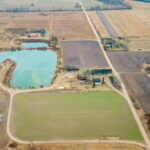
Everything starts with the land. The parcel you choose determines what you can build, how much the build will cost, and how long the process will take. A piece of land that looks straightforward from the road can carry significant hidden costs, including poor drainage, unstable soil, lack of utility access, or zoning restrictions that limit residential use.
Key factors to evaluate before purchasing:
- Soil type and load-bearing capacity: Clay-heavy soils common in Middle Tennessee can shift seasonally and require engineered foundation solutions. Sandy or rocky terrain in East Tennessee presents its own considerations.
- Topography and drainage: Sloped sites require more grading and earthwork. Low-lying areas can face recurring drainage problems that affect the foundation over time.
- Utility access: Electricity, water, and septic or sewer connections all carry costs that vary dramatically by how far the nearest service points are from your building site.
- Flood zone status: Tennessee has numerous FEMA-designated flood zones, particularly along river corridors. Building in or near a flood zone affects both your design requirements and your insurance costs.
- Zoning and deed restrictions: County zoning in Tennessee varies widely. Some counties have no zoning at all in unincorporated areas; others impose setback requirements, minimum square footage rules, or agricultural-use restrictions that affect how you build.
- Road and access: Seasonal or unpaved roads can complicate both the build process and daily living. Construction equipment needs reliable access throughout the project.
Professional land selection and site evaluation support in Tennessee can flag these issues before you commit to a purchase, which is far cheaper than discovering problems after closing.
For buyers considering a build in or around Nashville, land selection is particularly important. Williamson, Rutherford, and surrounding counties are growing fast, and permitting in those areas is considerably more complex than in rural Middle Tennessee. Connecting early with barndominium builders in Nashville, TN who already understand the specific requirements of the Metro Nashville market saves significant time and avoids costly site selection mistakes.
Here’s our land selection checklist guide.
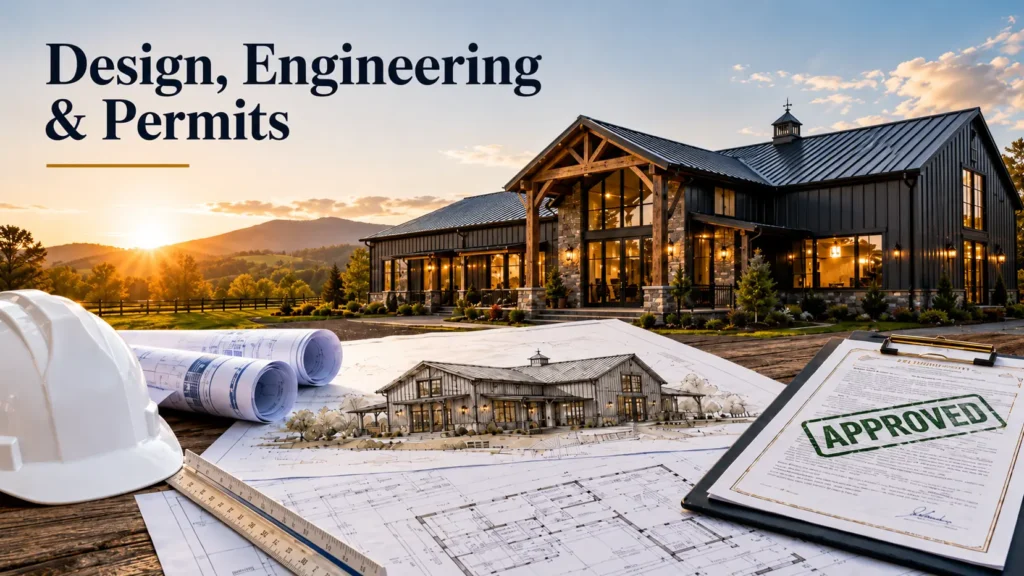
Stage 2: Design, Engineering, and Permits
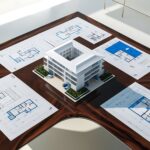
Once the land is secured and evaluated, the design and engineering phase begins. This is where the project takes shape on paper before anything moves in the ground.
Barndominium Design Considerations
Barndominium design starts with a clear picture of how you intend to use the space. Questions that shape every layout decision include:
- How many bedrooms and bathrooms are needed?
- Is garage space, workshop space, or equipment storage part of the same structure?
- Do you want a loft? A wraparound porch? A vaulted great room?
- Will you build in phases, or is this a single complete build?
The structural system of a barndominium differs from stick-frame construction. The primary structure is a steel frame, typically either post-frame (also called pole barn construction) or rigid-frame steel, depending on the span, load requirements, and design. Rigid-frame systems are more common in full residential barndominiums because they offer clean interior spans without interior columns interrupting the living space.
Learn more about permits and inspection for barndominiums in Tennessee.
Engineering Requirements in Tennessee
Tennessee requires engineered drawings for permitted residential structures in virtually all jurisdictions. This means a licensed structural engineer must review and stamp the plans before a building permit is issued. For metal-framed structures, engineering must address:
- Dead loads: The weight of the structure itself, including roof, walls, and finishes.
- Live loads: Occupant and furniture weight, as well as roof loads from people or equipment.
- Snow loads: Relevant across elevated parts of East Tennessee, particularly in the Great Smoky Mountain foothills and higher elevations.
- Wind loads: Tennessee sits in a region with occasional severe storms. Wind load requirements vary by county and elevation.
- Seismic loads: West Tennessee falls within a seismically active zone near the New Madrid Seismic Zone. Buildings in Shelby, Tipton, and surrounding counties face stricter seismic design requirements than most of the state.
Working with an experienced metal building company in Tennessee that already understands these county-by-county requirements saves significant time during the permit process.
Snow load and terrain requirements in East Tennessee, particularly in the foothills east of Knoxville, require specific engineering attention that differs from the rest of the state. Barndominium builders in Knoxville, TN who regularly work in Knox and surrounding counties understand how local elevation and topography affect the engineering specifications before a single plan is drawn.
The Permitting Process
Permit requirements differ depending on where in Tennessee you are building. In unincorporated rural counties without zoning, the permit process is often straightforward and handled at the county level. In cities, towns, or counties with active planning and zoning departments, the review process can take weeks and require additional documentation such as site plans, grading plans, and septic system approvals.
Common permits required for a Tennessee barndominium project:
- Building permit (structural)
- Electrical permit
- Plumbing permit
- Mechanical permit (HVAC)
- Septic system permit (if not connecting to municipal sewer)
- Driveway or road access permit (in some counties)
Starting permit applications early, often before finalising every interior detail, keeps the construction schedule on track.
Have a building-related question for Tennessee?
Stage 3: Site Preparation and Foundation Work
With permits in hand, physical work begins. Site preparation sets the foundation for everything that follows, literally and structurally.
Clearing and Grading
Clearing removes trees, brush, and any existing structures from the building footprint and surrounding work area. Grading reshapes the terrain to establish the correct elevation for the foundation, direct drainage away from the structure, and create a stable working surface. In Tennessee’s varied topography, from the flatlands of West Tennessee to the ridgelines of East Tennessee, grading requirements vary considerably from site to site.
Foundation Types for Tennessee Barndominiums
The foundation type chosen depends on soil conditions, site topography, frost depth, and the structural system of the building. Common options include:
- Concrete slab on grade: The most common foundation for Tennessee barndominiums. A reinforced concrete slab provides a level, durable floor surface and anchoring points for the steel frame. Slab thickness and reinforcement are engineered based on soil bearing capacity.
- Pier and beam (post and beam): Used where soil conditions or site slope make a full slab less practical. Concrete piers are drilled or poured at engineered intervals and support the frame above grade.
- Perimeter foundation with slab: A combination system where a perimeter concrete wall or block foundation supports the slab edges, offering additional lateral stability.
The clay soils common across West Tennessee expand when wet and contract when dry, creating seasonal movement that can crack a poorly engineered slab over time. Builds in the flat delta terrain west of the Tennessee River require specific foundation engineering to account for this. Experienced barndominium builders in West Tennessee design foundations with this soil behaviour factored in from the start, rather than applying a one-size approach from another region.
Stage 4: Steel Frame Erection
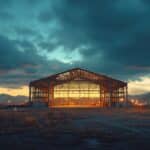
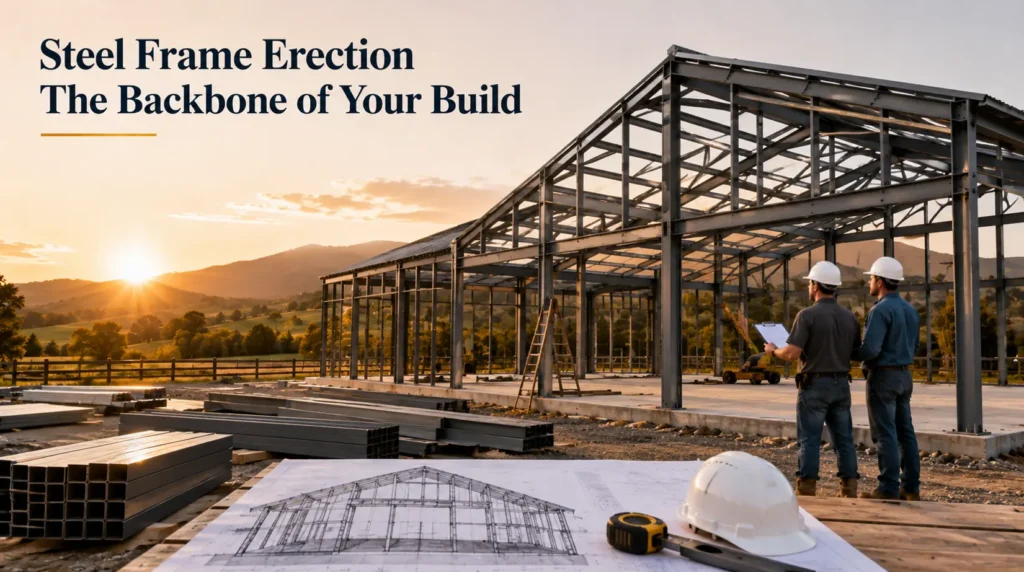
The steel frame is the structural skeleton of the barndominium. For a rigid-frame system, this involves primary frames, the large arching or pitched steel assemblies that define the width and height of the building, connected by secondary members: purlins along the roof and girts along the walls.
Frame erection is typically a multi-day process involving a crane and an experienced crew. The primary frames are set first, followed by secondary framing, bracing, and connection of the end walls. Once the frame is fully erected and plumb, the building takes its recognisable shape and the structure is ready for the exterior skin.
What to Watch During Frame Erection
- Anchor bolt placement: The anchor bolts cast into the foundation during concrete work must align precisely with the base plates of the steel frame. Misalignment causes significant problems at this stage and must be caught early.
- Plumb and square: The frame must be verified plumb (vertically true) and square before the roofing and cladding process begins.
- Bracing: Temporary bracing holds the frame in position during erection until permanent connections are complete.
In Shelby County and the surrounding West Tennessee counties near Memphis, seismic zone requirements add an additional layer to frame engineering. Connection specifications, anchor bolt sizing, and bracing design all need to meet the stricter standards that apply in that part of the state. Barndominium builders in Memphis, TN who build in this zone regularly understand what those specifications require and how they affect both cost and timeline.
Stage 5: Roofing and Exterior Cladding
Once the steel frame is up, the exterior envelope goes on. For barndominiums, this typically means metal roofing and metal wall panels, though exterior cladding options have expanded considerably in recent years.
Roofing Systems
The standard choice is a standing seam metal roof, a concealed-fastener system where panels interlock along raised seams with no exposed screws. This system is more durable and weather-tight than through-fastened roofing and offers a cleaner visual profile. Correctly installed standing seam roofing in Tennessee can last 40 to 60 years with minimal maintenance.
Roof pitch matters both aesthetically and functionally. Steeper pitches shed water and debris more effectively; shallower pitches reduce material costs but require tighter installation tolerances to manage Tennessee’s seasonal rainfall.
Exterior Wall Cladding Options
- Metal wall panels: Matching the roof material for a uniform industrial or agricultural aesthetic. Cost-effective and low maintenance.
- Board and batten steel siding: A profile that mimics traditional vertical wood siding while retaining the durability of steel.
- Brick or stone veneer: Applied over the metal frame with an appropriate drainage plane and attachment system. Popular in Middle Tennessee for a more traditional residential appearance.
- Hardie board or fibre cement: Blends well with conventional neighbourhood aesthetics for suburban or semi-rural sites.
The exterior choices also affect insulation strategy, particularly around thermal bridging through the steel frame, a consideration addressed in the insulation stage below.
Stage 6: Insulation – One of the Most Critical Decisions
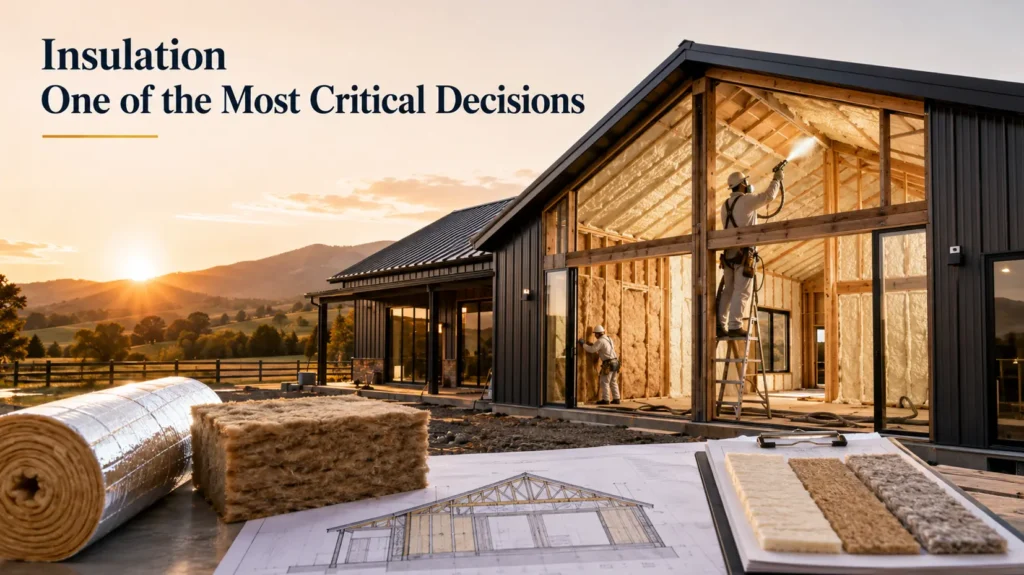
Insulation is where many barndominium projects make their most consequential mistake. Steel conducts heat and cold efficiently, and without the right insulation system, a metal building will be uncomfortable to live in and expensive to heat and cool in Tennessee’s climate, which can range from 0°F in a hard winter to 100°F+ in summer.
Spray Foam Insulation
Closed-cell spray polyurethane foam (SPF) is the most effective insulation choice for metal barndominium construction in Tennessee. It does three things simultaneously:
- Creates an air barrier, eliminating infiltration
- Acts as a vapour barrier, preventing condensation on the cold steel in winter
- Provides high R-value per inch (closed-cell SPF achieves R-6 to R-7 per inch)
Condensation on uninsulated or poorly insulated metal is a major issue in Tennessee’s humid climate. Without a proper vapour control layer, warm interior air contacts the cold steel in winter, condensation forms, and rust or mould follows. Spray foam applied directly to the interior face of the metal panels eliminates this problem.
Fiberglass Batts and Blanket Insulation
Some projects use traditional fiberglass batt insulation between wall girts. This is lower cost but requires careful air sealing around every penetration to be effective. Without excellent air sealing, batt insulation alone is insufficient for Tennessee’s climate.
Hybrid Systems
A hybrid approach, using a layer of closed-cell spray foam on the metal surface to control condensation and vapour, followed by additional blown-in or batt insulation to increase total R-value, can offer a cost-effective balance between performance and budget.
Learn more about how Tennessee weather affects barndominium insulation.
Want to speak to a qualified barndo builder in Tennessee?
Stage 7: Rough-In Mechanical Systems
Before interior walls are framed and drywall goes up, the rough-in phase installs the primary mechanical systems through the structure. This covers electrical, plumbing, and HVAC.
Electrical Rough-In
A barndominium requires a full residential electrical system, including:
- Service entrance and main panel (sized appropriately for the square footage and any workshops or outbuildings)
- Sub-panels where needed (garages, workshops, detached structures)
- Wiring runs for outlets, lighting, appliances, and HVAC equipment
- Low-voltage wiring for data, security, audio, and communications
Tennessee follows the National Electrical Code (NEC), adopted with local amendments in most jurisdictions. All electrical work must be inspected before it is covered.
Plumbing Rough-In
Plumbing rough-in sets the drain, waste, and vent (DWV) system in place and brings supply lines to the locations of future fixtures. In slab-on-grade construction, the most common foundation type for Tennessee barndominiums, plumbing penetrations through the slab must be planned and installed before the concrete is poured. Getting this right requires accurate coordination between the foundation phase and the plumbing contractor.
Septic system design is a separate but related consideration. Tennessee’s Division of Water Resources regulates septic system permitting. System size is determined by the number of bedrooms in the home and the results of a soil percolation test conducted on the site. In rural areas around Jackson, where municipal sewer connections are often unavailable on outlying parcels, getting the septic design right early is essential. A knowledgeable barndominium builder in Jackson, TN will coordinate septic permitting alongside the building permit process rather than treating it as an afterthought.
HVAC Systems
Heating and cooling a metal-framed barndominium in Tennessee requires a system sized for the actual thermal performance of the building envelope, not just the square footage. Common system types include:
- Mini-split heat pump systems: Highly efficient, particularly in smaller to mid-sized barndominiums. Multiple indoor units can zone the space effectively without ductwork.
- Ducted central HVAC: More traditional approach, appropriate for larger floor plans. Duct placement in a barndominium with open ceilings requires careful planning to maintain aesthetics and efficiency.
- Geothermal systems: Available in Tennessee but less common due to higher upfront cost. Ground temperatures in Tennessee are relatively stable, making geothermal viable in the right conditions.
Stage 8: Interior Framing and Finishes
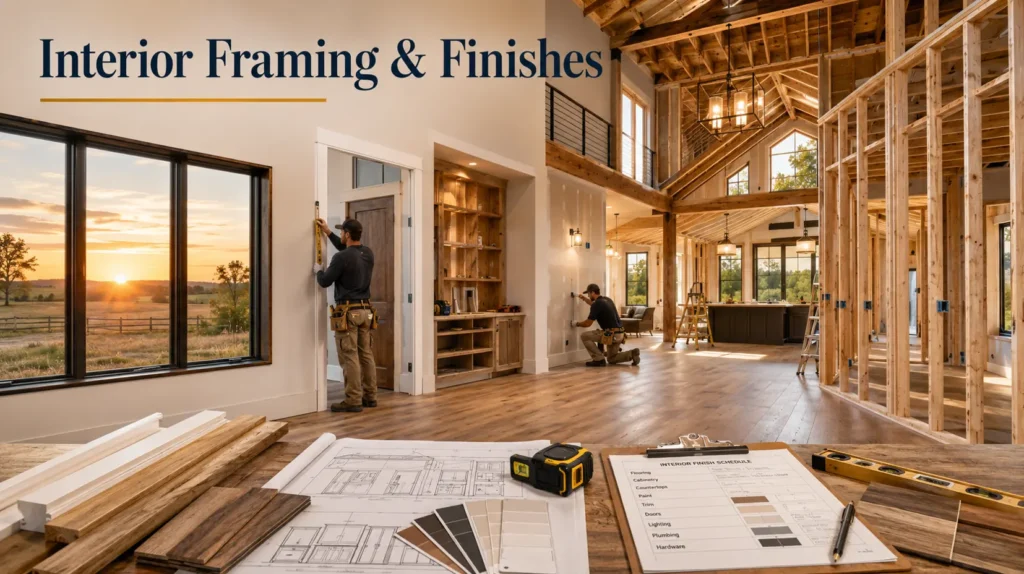
With the mechanical rough-ins complete and inspected, interior framing defines the walls, rooms, and features of the living space. This is where the barndominium transitions from a metal building into a home.
Interior Wall Framing
Interior walls are typically framed in steel stud or wood framing, depending on builder preference and local supply. Steel stud framing is dimensionally stable and resistant to the moisture issues that can affect wood in Tennessee’s humid climate. Rooms, hallways, closets, bathrooms, and any loft structures are all defined at this stage.
Drywall and Ceiling Systems
Drywall is the standard interior finish for barndominium walls and ceilings. The high ceilings common in barndominium designs, often 10 to 14 feet in living areas, create a dramatic sense of space that is one of the most frequently cited advantages of the building type. Coffered ceilings, exposed wood beams, and shiplap accent walls are common interior design choices that work naturally within the barndominium’s structural system.
Flooring Options
- Polished concrete: Left from the slab, with grinding and sealing. Industrial-modern aesthetic, durable, and easy to clean.
- Luxury vinyl plank (LVP): Waterproof, dimensionally stable, and available in a wide range of hardwood-look finishes. One of the most popular choices.
- Hardwood: Works well in living areas but requires careful moisture management in Tennessee’s climate.
- Tile: Standard choice for bathrooms and utility areas.
Kitchen, Bath, and Interior Fixtures
From cabinetry to countertops, plumbing fixtures, lighting, and door hardware, the finish selection process mirrors that of any custom home build. Barndominiums offer significant flexibility in layout and finish level. Working with experienced custom home builders in Tennessee who understand both the structural realities of metal-framed construction and the expectations of residential interior finishing keeps this phase from becoming disconnected from the rest of the project.
In fast-growing suburban markets like Franklin, interior finish expectations often match or exceed those of high-end conventional construction. Buyers building in Williamson County should work with barndominium builders in Franklin, TN who are familiar with both the finish standards that local buyers expect and the specific planning requirements that Williamson County applies to residential metal-framed structures.
Stage 9: Exterior Completion and Landscaping
While interior work proceeds, exterior completion runs in parallel or follows immediately after. This includes:
- Windows and exterior doors: Sized and placed during the design phase but installed during or after framing. Thermal performance of windows matters in Tennessee’s climate; double-pane or triple-pane units with low-E coatings are standard.
- Gutters and downspouts: Essential for managing Tennessee’s annual rainfall, which averages 50 to 55 inches across most of the state. Proper gutter sizing and placement protects the foundation from water accumulation.
- Driveway and access: Gravel or paved driveway access completed to support move-in.
- Grading and erosion control: Final site grading ensures water moves away from the structure. Seed, sod, or erosion control matting stabilises disturbed soil.
Stage 10: Final Inspections and Certificate of Occupancy
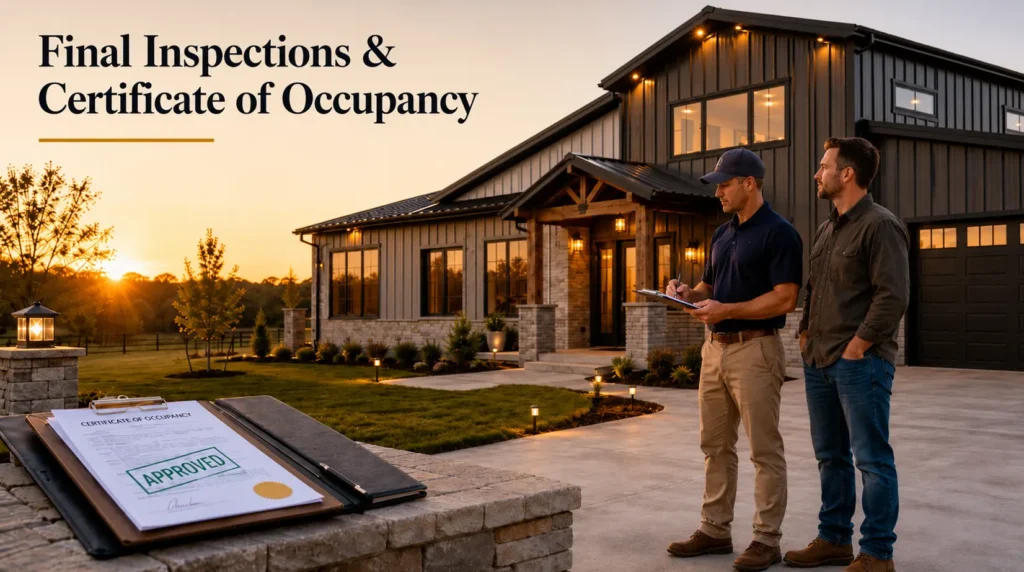
No barndominium in a permitted jurisdiction can be occupied legally without passing final inspections and receiving a Certificate of Occupancy (CO). Inspections are conducted by the local building department and cover:
- Structural completion
- Electrical systems
- Plumbing systems
- Mechanical (HVAC) systems
- Energy code compliance (where applicable)
- Fire and life safety requirements
Tennessee adopted the International Residential Code (IRC) with state amendments, and most counties enforce this code for residential construction. The CO confirms that the structure meets the code requirements approved during permitting.
Read our comprehensive guide on cost to build a barndominium in Tennessee.
Hiring the Right Builder: What to Look For in Tennessee
The builder you choose is the most consequential decision of the entire project. A full-service, turnkey builder handles every phase in-house, from design and engineering through site work, framing, mechanical systems, and interior finishing. This eliminates the coordination problems that arise when separate contractors hand off work between phases.
Key questions to ask any barndominium builder in Tennessee:
- Do they self-perform construction, or do they subcontract the structural and mechanical work?
- Do they have experience building in your specific county, including navigating local permit requirements?
- Can they assist with land evaluation before purchase?
- Do they provide engineering drawings stamped by a Tennessee-licensed engineer?
- Do they offer financing guidance or referrals?
Regional knowledge matters more than most buyers realise at the outset. A builder who works exclusively in East Tennessee brings different expertise than one focused on the Nashville corridor. If you are building in the eastern part of the state, working with East Tennessee barndominium builders who understand the local terrain, ridge and valley topography, and county-specific code requirements gives your project a measurable advantage from the design phase forward.
Across the broader central region, builders with experience across Middle Tennessee understand the varied mix of rural and suburban county requirements that apply depending on how close your site is to a city centre. What applies in a Maury County build differs from what you will encounter in Williamson or Davidson County, and that difference affects both design and timeline.
The most reliable path through the entire construction process is a fully turnkey barndominium builder in Tennessee that manages design, engineering, permitting, site work, construction, and finishing under a single contract with a single point of accountability.
Find out what’s the difference between shell and turnkey build in Tennessee.
Understanding Costs: What Drives the Budget in Tennessee
Barndominium build costs in Tennessee vary significantly based on size, finish level, site conditions, and location. Rough cost benchmarks for orientation:
- Shell only (structure, roof, exterior panels, no interior finishing): $40 to $70 per square foot
- Turnkey build, standard finishes: $120 to $180 per square foot
- Turnkey build, high-end finishes: $180 to $250+ per square foot
These are general reference points, not fixed prices. A flat, easily accessible rural lot in a low-regulation county builds for less than a sloped, wooded site in a high-growth suburban county with complex permitting. Mechanical systems, insulation choices, and finish selections all move the number substantially.
Key cost variables specific to Tennessee:
- Septic system: Required on most rural parcels. Cost ranges from $8,000 to $20,000+ depending on system type and site conditions.
- Well drilling: Where municipal water is not available, well drilling in Tennessee typically runs $6,000 to $15,000 depending on depth and geology.
- Site work: Clearing, grading, and foundation work on challenging terrain can exceed the cost of these same items on a flat, accessible site by 30 to 50%.
- County permit fees: Vary from under $1,000 in some rural counties to several thousand dollars in high-growth suburban jurisdictions.
Understanding barndominium financing in Tennessee options early in the planning process is important. Not all lenders handle barndominium construction loans in the same way, and some rural areas are better served by specific loan products such as USDA construction loans or agricultural lenders familiar with the property type.
Get an answer to the most common question: Are barndominiums cheaper to build than houses in Tennessee?
Common Mistakes to Avoid When Building a Tennessee Barndominium
Experience across hundreds of builds surfaces the same errors repeatedly. Avoiding them saves money, time, and frustration:
- Buying land before evaluating it properly: Soil conditions, drainage, utility access, and zoning should all be verified before any purchase commitment.
- Underestimating site work costs: Site preparation, foundation, and utility connection regularly account for 20 to 30% of total project cost and are frequently underestimated in early budgets.
- Skipping engineering: Unpermitted or under-engineered structures create problems at resale, with insurance, and in the event of severe weather.
- Wrong insulation strategy: Using batt insulation without addressing condensation on metal surfaces is one of the most common and most costly mistakes in metal building construction.
- No contingency budget: A 10 to 15% contingency on top of the build estimate is a reasonable standard. Unexpected site conditions, material price changes, and scope adjustments are normal in any construction project.
- Choosing a builder based on price alone: The lowest bid does not mean the best outcome. Vetting builder experience, references, and in-house capacity matters more than the initial price difference.
Working with established Tennessee barndominium contractors who carry the full scope of construction experience in-house, not just the steel package, reduces the likelihood of these errors significantly.
Tennessee-Specific Considerations Worth Knowing
County Variation
Tennessee has 95 counties with varying levels of zoning, permitting complexity, and code enforcement. Some counties operate with minimal building regulation in unincorporated areas; others, particularly suburban counties around Nashville, Knoxville, and Chattanooga, have detailed planning and zoning requirements. Knowing the regulatory environment of your target county before you design and understanding the county, city and rural building rules in Tennessee saves significant rework.
Climate Zones
Tennessee spans three IECC climate zones: Zone 3 in the western and central lowlands, Zone 4 in most of the middle and eastern portions, and Zone 5 at higher elevations in the eastern mountains. Insulation R-value requirements and energy code compliance differ between these zones and affect the insulation and HVAC specifications for the project.
HOA Restrictions
Not all rural land is HOA-free. Some subdivisions and planned developments in Tennessee include deed restrictions that prohibit metal-sided structures or barndominiums specifically. Reviewing any deed restrictions or HOA covenants before purchasing land is essential.
Wildfire and Storm Exposure
While Tennessee does not face the wildfire risk levels of western states, areas of East Tennessee and the Cumberland Plateau have seen increasing wildfire activity. Metal exterior construction offers inherent fire resistance. The state also experiences significant tornado risk, particularly across Middle and West Tennessee. Local storm shelters and safe room provisions are worth considering during the design phase.
Learn what makes building a barndominium in Tennessee different from other states.
Conclusion
Building a barndominium in Tennessee is a practical, achievable project when you understand the full scope of what it involves, from selecting the right land and securing permits through every construction phase to final inspection and move-in. The key variables are site conditions, county-specific requirements, insulation strategy, and builder selection. Getting these right, in sequence, is what separates a smooth build from a costly one.
Tennessee Complete Barndo Solutions manages every phase of the process in-house, across all 95 Tennessee counties. From land evaluation and design through full construction and interior finishing, the same team carries your project from start to finish. No handoffs, no subcontracted structural work, and no guesswork about who is accountable for what.
Frequently Asked Questions
How long does it take to build a barndominium in Tennessee?
A full turnkey barndominium build in Tennessee typically takes 8 to 14 months from design through Certificate of Occupancy. The timeline depends on county permit processing times, site complexity, structure size, and finish level. Pre-design land evaluation and financing approvals, which happen before the clock starts on construction, can add additional time. Rural counties with streamlined permitting tend to move faster than suburban jurisdictions with more complex review processes.
Do I need a building permit for a barndominium in Tennessee?
Yes, in virtually all cases. Any new residential structure in Tennessee requires a building permit along with separate permits for electrical, plumbing, and mechanical work. Some very rural counties without formal zoning still require permits at the county level. Building without a permit creates serious problems: the structure may not be insurable, it cannot be legally occupied, and it will create significant issues at resale. Always permit correctly from the start.
Can you get a mortgage on a barndominium in Tennessee?
Yes, barndominiums can be financed in Tennessee, though the lending landscape differs from conventional stick-built homes. USDA construction loans, FHA construction loans, farm credit lenders, and some portfolio lenders are the most common routes. Conventional Fannie Mae/Freddie Mac financing is possible but requires the property to meet specific appraisal criteria, including comparable sales of similar properties in the area. Working with a lender who has direct experience with barndominium financing in Tennessee is essential.
What is the most common mistake people make when building a barndominium in Tennessee?
Underestimating site work costs and skipping proper insulation engineering are the two most frequent issues seen across the industry. Many buyers budget around the building itself and treat site preparation, foundation, utility connections, and septic as secondary line items, when in reality these can represent 25 to 35% of total project cost on sites with any complexity. On the insulation side, applying standard batt insulation without addressing condensation on the metal frame leads to ongoing moisture problems that are expensive to remediate after the fact.
What size barndominium can I build in Tennessee?
There is no universal size limit. The appropriate size depends on your land, zoning, septic system capacity, and budget. Tennessee’s residential building codes set minimum habitable space requirements (typically 70 square feet per room, with minimum room dimensions), but there is no upper limit imposed by the state. County-level rules may impose setbacks, impervious surface limits, or lot coverage maximums that indirectly constrain building footprint on smaller parcels. Your builder and local county planning office are the right resources for site-specific constraints.