Tennessee has 95 counties, and no two handle barndominium construction quite the same way. One county might wave through a residential build on agricultural land with a phone call to the zoning office. The next county over might require stamped engineered drawings, a septic permit, and three separate inspections before the slab is poured. This guide breaks down how county, city, and rural rules differ across the state, what triggers a permit, and where projects tend to stall when the local requirements are not understood upfront.
Understanding Tennessee’s Patchwork of Building Regulations
Tennessee does not run building regulation from a single state office. Counties and municipalities set their own zoning ordinances, decide which building code edition applies, and determine how strictly barndominiums are reviewed. Some counties adopt the 2018 International Residential Code, others still enforce the 2015 or 2012 edition, and a handful of rural counties have no local building department at all. That means the rules that apply to a barndominium on one side of a county line can look completely different from the rules just a few miles away.
This is why regional experience matters so much on a barndominium project. Working with barndominium builders in Tennessee who already know which counties require plan review, which ones exempt agricultural structures, and which municipalities enforce stricter aesthetic codes saves weeks of back and forth with local officials.
County-Level Rules and Why They Vary So Much in Tennessee
At the county level, the biggest factor is whether the property sits inside an incorporated city limit or in an unincorporated area. Unincorporated county land generally has fewer restrictions, but “fewer” does not mean “none.” Many counties still require a permit, a site plan, and proof that the structure meets basic safety standards for electrical, plumbing, and structural work.
Some counties draw a hard line at square footage. A residential or agricultural building under 5,000 square feet may not need stamped architectural drawings, while anything larger, or anything intended as a full-time residence rather than a barn, typically does. This distinction matters directly for barndominiums, since they blur the line between agricultural structure and residential home. An experienced team of Tennessee barndominium contractors will confirm this classification with the county before finalizing a design, since getting it wrong after permitting has started can force a redesign.
Common county-level variables that affect a barndominium project include:
- Whether a permit is required at all in unincorporated areas
- Which edition of the International Residential Code the county enforces
- Whether stamped, engineered drawings are required for the size of the structure
- Whether accessory buildings and true barns are treated differently from a barndominium used as a full-time residence
- How many inspections are scheduled during construction, and at what stages
City and Municipal Requirements Inside Tennessee’s Growing Metro Areas
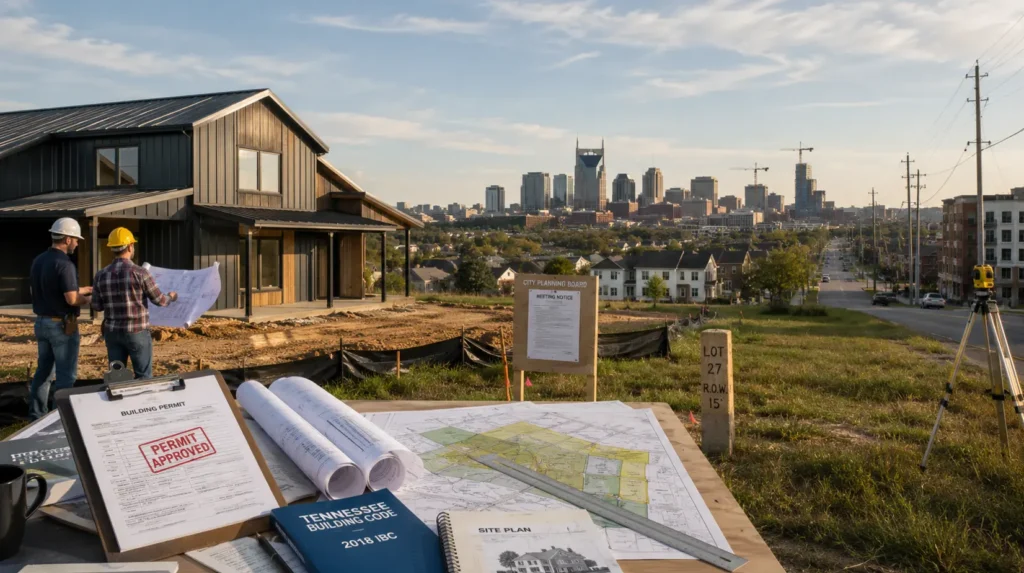
Building inside a city limit almost always means a more detailed review process than building in the surrounding county. Municipalities near fast-growing metro areas tend to have dedicated planning departments, formal zoning boards, and stricter enforcement of setbacks, lot coverage, and exterior materials.
Around Nashville, this shows up as higher scrutiny on lot size, drainage, and architectural compatibility with surrounding neighborhoods. Property owners working with barndominium builders in Nashville, TN often find that permitting timelines run longer than in a rural county simply because more departments are involved in sign-off.
Knoxville and the surrounding areas follow a similar pattern, with topography adding another layer of review. Steep lots and ridge-adjacent parcels can trigger additional grading or drainage requirements before a permit is issued, which is why barndominium builders in Knoxville, TN factor site topography into the planning stage rather than after the fact.
Franklin and the wider Williamson County corridor sit at the intersection of rapid growth and detailed zoning oversight, with some of the more demanding setback and lot-coverage rules in the state. Teams familiar with building requirements in Franklin know to confirm zoning classification before a lot is even purchased, since not every parcel in the area permits a barndominium-style structure outright.
See the complete guide to building a barndominium in Tennessee.
Rural Land and Unincorporated Areas: What’s Different
Rural Tennessee is generally more accommodating to barndominium construction than city or suburban zones, largely because agricultural and residential uses have historically overlapped on the same parcels. Many rural counties classify barndominiums similarly to single-family homes when the land is zoned residential or agricultural, which simplifies approval compared to a mixed-use or commercial zone.
That flexibility does not remove every obstacle. Rural land often comes without municipal water, sewer, or graded road access, and some rural subdivisions carry deed restrictions that prohibit metal-sided structures even though the county itself has no such rule. This is one of the reasons land selection and site evaluation support in Tennessee is worth arranging before closing on a property, since a parcel that looks ideal on paper can carry restrictions that only surface during a title search or a call to the homeowners association.
Want to speak to barndo builder in Tennessee?
Zoning Classifications and How They Affect Barndominium Approval
Zoning determines what can legally be built on a parcel before a single building code question even comes up. Tennessee zoning generally falls into a few broad categories, and each one treats a barndominium differently.
- Residential zoning usually allows a barndominium as a primary dwelling, subject to setback and lot coverage rules
- Agricultural zoning often permits barndominiums more freely, since the structure resembles a farm building even when used as a home
- Mixed-use zoning can require additional review to confirm the structure qualifies as a residence rather than a commercial or accessory building
- Commercial or industrial zoning typically does not permit residential barndominium construction without a formal rezoning request
Minimum lot sizes, height restrictions, and setback distances from property lines also vary by zone and by county, so confirming zoning classification is one of the first steps in any barndominium project, well before floor plans are finalized.
Building Codes, Permits, and Inspections Across Tennessee
Once zoning is confirmed, the building code takes over. Tennessee generally follows the International Residential Code, but the specific edition, and how strictly it is enforced, depends on the county or city issuing the permit. A permit application typically needs a site plan, construction drawings, and documentation covering structural, electrical, plumbing, and septic work.
A turnkey barndominium builder in Tennessee that handles design and engineering in-house can align the construction drawings with the specific code edition and inspection sequence a given county requires, rather than submitting a generic plan set and hoping it passes review.
Typical permit and inspection stages include:
- Initial permit application with site plan and construction drawings
- Foundation and framing inspections
- Electrical, plumbing, and mechanical inspections
- Final inspection before the certificate of occupancy is issued
Septic, Utilities, and Rural Site-Specific Considerations
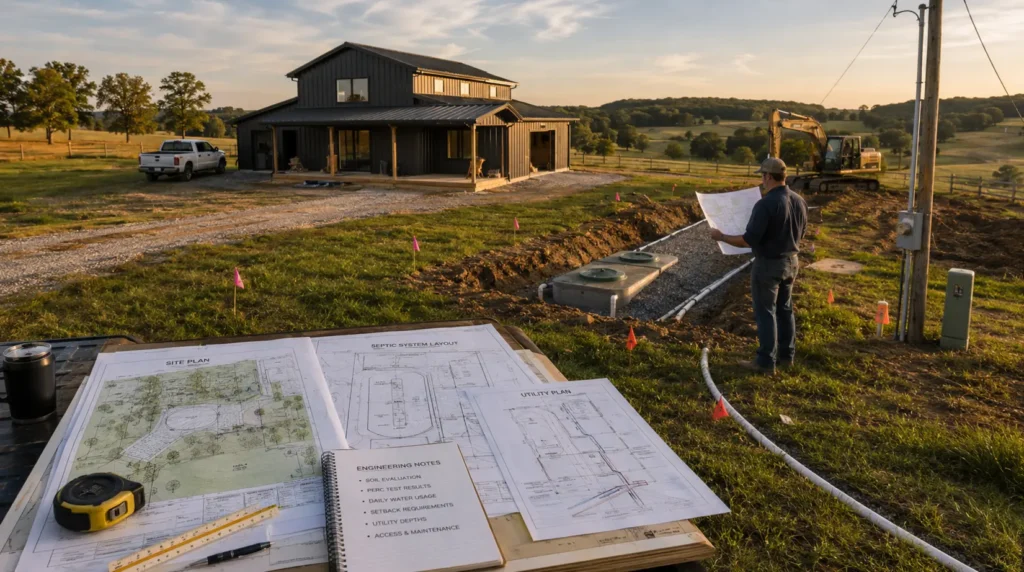
Many rural Tennessee properties fall outside municipal sewer service, which means a private septic system requires approval through the Tennessee Department of Environment and Conservation. Before that approval is granted, a percolation test evaluates whether the soil can absorb wastewater, and that result determines the type and size of septic system the property needs.
Utility access follows a similar pattern. Electric hookups on rural land can run from around a thousand dollars to well over ten thousand, depending on distance from existing lines, and unpaved or seasonal roads can complicate both construction access and daily use once the home is finished. West Tennessee sites, including land near Memphis, sometimes carry additional floodplain review depending on proximity to the river system, which is one reason Barndominium builders in Memphis, TN routinely check flood zone maps before finalizing a site plan.
Find out what makes Tennessee barndominium projects different from other states.
Common Mistakes When Navigating Local Building Rules
Most delays on Tennessee barndominium projects trace back to a handful of avoidable mistakes made early in the process, often before construction has even begun.
- Assuming rural land has no rules simply because the county has no formal zoning map
- Skipping a title and deed restriction search that might prohibit metal-sided structures
- Submitting construction drawings built for the wrong International Residential Code edition
- Overlooking septic and percolation testing until after a floor plan is finalized
- Underestimating utility connection costs on land without existing service
Find our comprehensive guide on the costs to build a barndominium in Tennessee.
Have a building-related question for Tennessee?
Regional Differences Across Tennessee’s Three Grand Divisions
Tennessee spans three distinct climate zones under the International Energy Conservation Code, and regional terrain adds another layer of variation on top of that. Insulation and HVAC specifications that satisfy code in the western lowlands will not automatically meet requirements in the higher elevations of the eastern mountains. The state’s three Grand Divisions, East, Middle, and West Tennessee, each bring their own mix of terrain, growth pressure, and permitting culture.
East Tennessee
In the eastern part of the state, ridge and valley topography shapes both site access and drainage requirements, which is why East Tennessee barndominium builders often plan grading and foundation work around terrain features that would not come up on a flatter site elsewhere in the state. Elevation also drives the building code itself, since higher ground in the eastern mountains falls into a stricter energy code zone than the valleys below, and snow load requirements in the foothills east of Knoxville call for engineering attention that flatter counties do not need.
Chattanooga and the surrounding Hamilton County area combine city-level review with rural county land just outside the municipal boundary, so the same buyer might face very different requirements depending on which side of a line their parcel sits. Barndo builders in Chattanooga, TN typically confirm this boundary status before submitting any permit paperwork.
Middle Tennessee
Across the central part of the state, the mix of rural and suburban county requirements shifts noticeably depending on distance from a city center. Builders working across Middle Tennessee deal with everything from minimal-oversight rural counties to fast-growing suburban ones in the same general region, sometimes on projects only a short drive apart. Counties ringing Nashville, including Williamson, Rutherford, and Montgomery, have added more formal plan review in recent years as new subdivisions and larger lot sizes push barndominium projects closer to areas that once saw almost no regulation at all.
West Tennessee
West Tennessee sits in a lower, flatter landscape than the rest of the state, with lighter energy code requirements in most counties but added structural attention near the Mississippi River corridor, where seismic design standards apply because of proximity to the New Madrid Seismic Zone. Growth around Jackson and Madison County has brought more formal permitting processes than in past decades, while still remaining less restrictive than the counties surrounding Nashville. A barndominium builder in Jackson, TN familiar with that shift can help set realistic expectations for how long approval will take.
Learn how long it typically takes to build a barndo in Tennessee.
How Six of Tennessee’s Growing Counties Handle Barndominium Permits
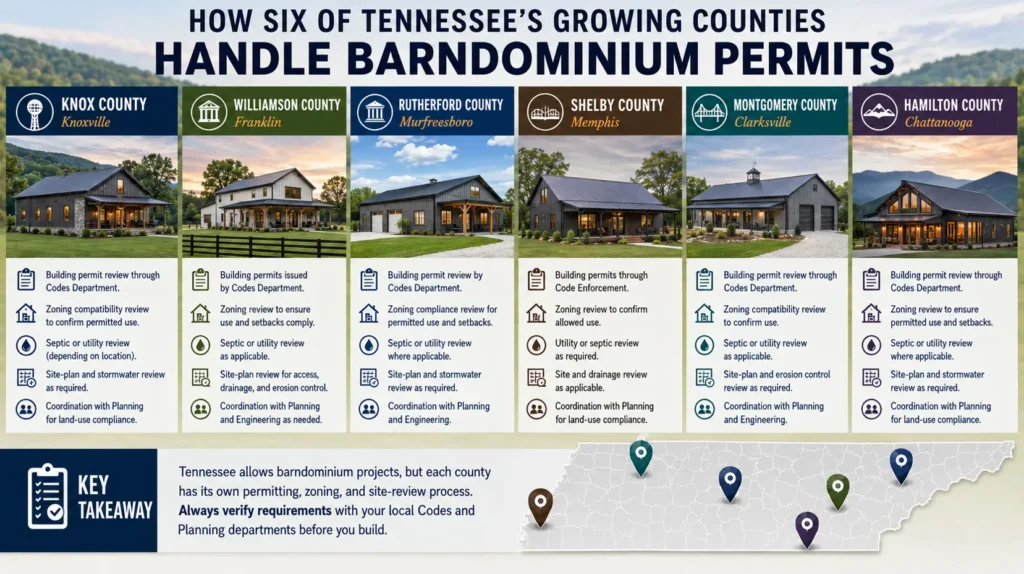
Statewide patterns are useful, but county-level detail is what actually determines how a permit application moves through review. The six counties below represent some of Tennessee’s fastest-growing areas, and each treats barndominium construction a little differently.
Knox County
Knox County requires a permit and inspections for every building on a property, including accessory structures, with no blanket exemption for agricultural buildings. Stamped, engineered drawings are required once a structure passes 5,000 square feet or is built for commercial use, which places most full-size barndominiums squarely in stamped-drawing territory. The county runs permitting through a centralized online portal, and zoning variances or appeals go through the county’s Board of Zoning Appeals rather than a city office.
Williamson County
Williamson County enforces one of the more detailed zoning ordinances in the state, adopted countywide and covering everything from lot density to building setbacks in unincorporated areas. Because barndominiums fall outside a standard single-family home definition in some zoning districts, a property that is not explicitly zoned for residential or mixed agricultural use may need a special use permit before construction can begin. Confirming this classification with the Building Codes Department early avoids a redesign after plans are already drawn.
Rutherford County
Rutherford County calls out barndominiums by name in its permitting rules, grouping them with container homes and other unconventional building methods that trigger additional plan review beyond a standard single-family application. A zoning compliance review is required for any property not already part of an approved, recorded subdivision plat, and proof of an approved sewage disposal system is required before a permit is issued. Builders serving Murfreesboro and the surrounding county are used to walking clients through this extra documentation step.
Shelby County
Shelby County requires permits and inspections for all new construction, and any project in a designated flood hazard area needs a separate floodplain development permit before work begins. Because Shelby County sits closer to the New Madrid Seismic Zone than most of the state, new construction and additions over 400 square feet must meet added seismic design requirements, which affects foundation and framing specifications for a barndominium in ways that counties farther east do not encounter.
Montgomery County
Montgomery County ties building permits to an Adequate Facilities Tax that must be paid in full before a permit is issued, and any property under five acres that is not part of a platted subdivision needs a minor plat recorded with the Register of Deeds first. Proximity to Fort Campbell has also shaped local housing policy, with more flexibility built into accessory dwelling unit rules to accommodate military families. Projects around Clarksville and the surrounding county fall under this same permitting structure.
Hamilton County
Hamilton County’s Building Inspection Department handles permitting and code enforcement for unincorporated areas and for any municipality that has not adopted its own building code, which means a property just outside Chattanooga’s city limits may actually be permitted through the county rather than the city. Zoning appeals and variance requests go through the county’s Board of Zoning Appeals, and stamped drawing requirements are confirmed on a case-by-case basis depending on the size and classification of the structure.
Learn more about a cost of build comparison between a barndo and a house.
Conclusion
Tennessee building rules for barndominiums are shaped almost entirely by location, down to the specific county and even the side of a city boundary a parcel sits on. Zoning classification, the building code edition in force, permit requirements, and septic or utility considerations all shift from one jurisdiction to the next, sometimes within a matter of miles. Confirming these details before finalizing a design, rather than after breaking ground, is what keeps a project on schedule. Understanding this local variation from the outset is the single biggest factor in avoiding delays, redesigns, and unexpected costs.
Frequently Asked Questions
Do you need a permit to build a barndominium in Tennessee?
In most jurisdictions, yes, though the scope varies. Some rural counties only require electrical and septic permits for a residential barndominium, while cities and suburban counties typically require a full building permit, plan review, and inspections throughout construction.
Are barndominiums legal everywhere in Tennessee?
Barndominiums are allowed in most of the state as long as the property is zoned for residential or agricultural use and the structure meets applicable building codes. Some subdivisions carry deed restrictions that prohibit metal siding or barndominium-style homes even where county zoning would otherwise allow it.
Is it easier to build a barndominium in a rural Tennessee county than in a city?
Generally, yes. Many rural counties have lighter permitting requirements and, in some cases, have opted out of state residential building programs entirely. Cities and fast-growing suburban counties tend to enforce more detailed zoning, setback, and architectural standards.
What building code applies to a Tennessee barndominium?
Most Tennessee jurisdictions base their requirements on the International Residential Code, though the specific edition adopted, such as the 2012, 2015, or 2018 version, differs by county. Some counties without a local building department leave enforcement to state agencies instead.
Do barndominiums in rural Tennessee still need a septic permit?
Yes, in nearly all cases. Rural properties without access to municipal sewer service require a septic system approved through the Tennessee Department of Environment and Conservation, and the required system size is tied directly to the home’s bedroom count and expected occupancy.