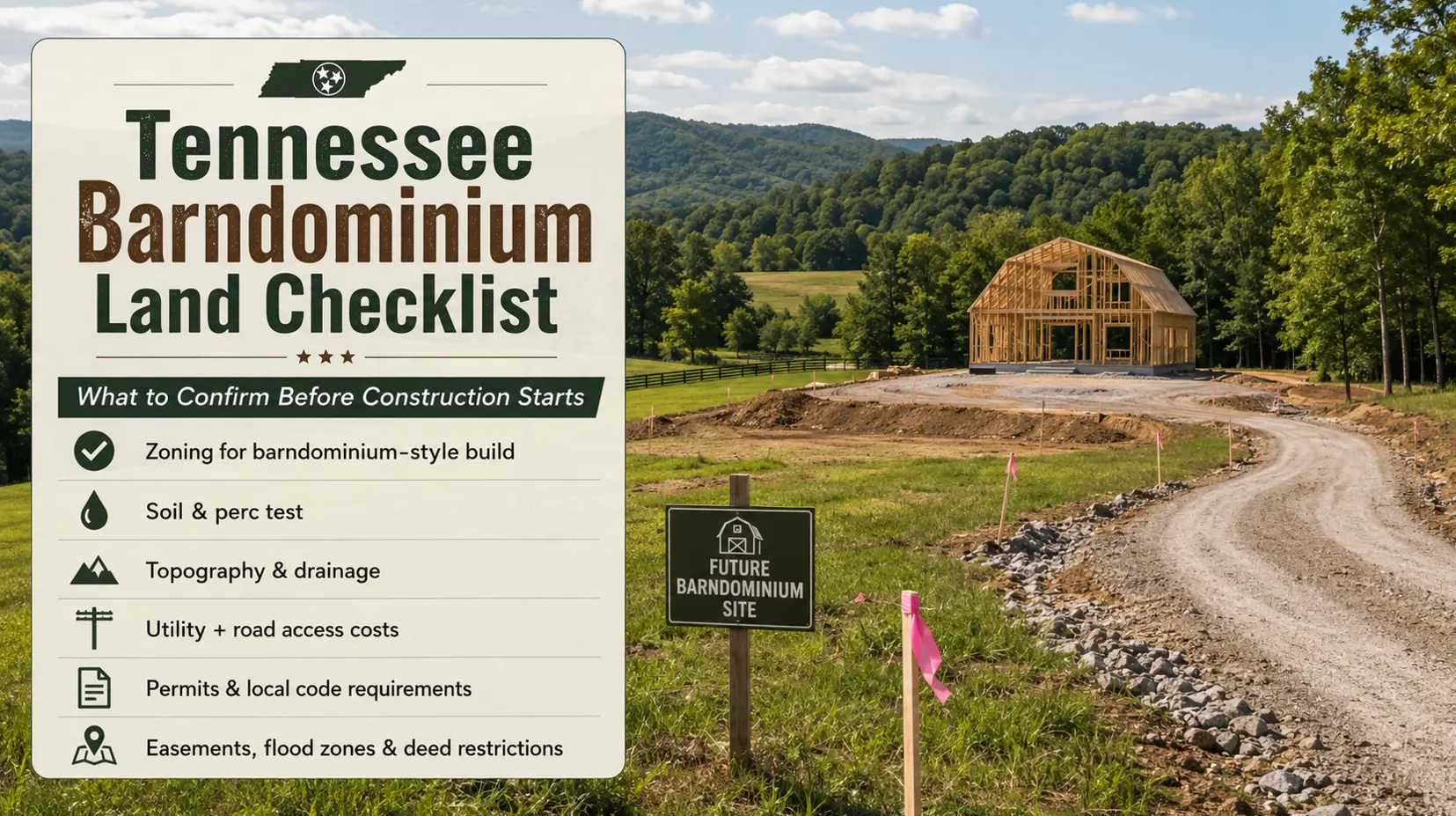
Not every piece of land in Tennessee is ready to carry a barndominium, even if it looks perfect on paper. Zoning, soil conditions, septic feasibility, and utility access all determine whether a lot can legally and physically support your build. This checklist walks through what to confirm before you sign a purchase agreement, so you avoid buying land that turns out to be unbuildable or far more expensive to develop than expected.
TL;DR
- Confirm zoning allows a barndominium-style structure before you make an offer
- Get a soil and percolation (perc) test to verify the land can support a septic system
- Check topography and drainage, since slope and soil vary widely across Tennessee’s regions
- Get written cost estimates for electric, water, and road access before closing
- Verify local permitting and building code requirements, since enforcement differs by county and city
- Watch for easements, flood zone status, and deed restrictions that could limit what you can build
Why Land Evaluation Matters More for Barndominiums
A barndominium combines a steel-framed structure with residential living space, and that hybrid nature means it gets evaluated differently than a typical stick-built house in many Tennessee counties. Some jurisdictions treat it as a standard single-family residence. Others classify it closer to an accessory or agricultural structure, which changes the permitting path entirely.
Land that would be perfectly fine for a conventional home can still create problems for a barndominium if the local code official is unfamiliar with the structure type, or if the parcel’s zoning designation restricts metal-clad residential buildings. Confirming how your specific county classifies barndominiums is the first real step, well before you start comparing floor plans.
Confirm Zoning and Land Use Before You Buy
Zoning determines what you are legally allowed to build on a given parcel, and it varies significantly across Tennessee. Many rural and agricultural counties have little or no formal zoning, which gives landowners more flexibility. Areas closer to Nashville, Knoxville, Chattanooga, and Memphis tend to enforce stricter residential and mixed-use zoning, along with historic or conservation overlays in some pockets.
Before making an offer, check:
- Whether the parcel is zoned residential, agricultural, or mixed-use
- Whether metal-sided or barndominium-style structures are explicitly permitted
- Any minimum lot size or acreage requirements tied to the zoning designation
- Setback distances from roads, property lines, and water features
- Deed restrictions or HOA covenants that could prohibit the structure entirely, even if county zoning allows it
Zoning offices are typically run at the county or municipal level, so the same style of build can be welcomed in one county and restricted a few miles away. A quick call to the local planning or codes department before closing on land can save months of delay later.
Check Soil Conditions and Site Topography
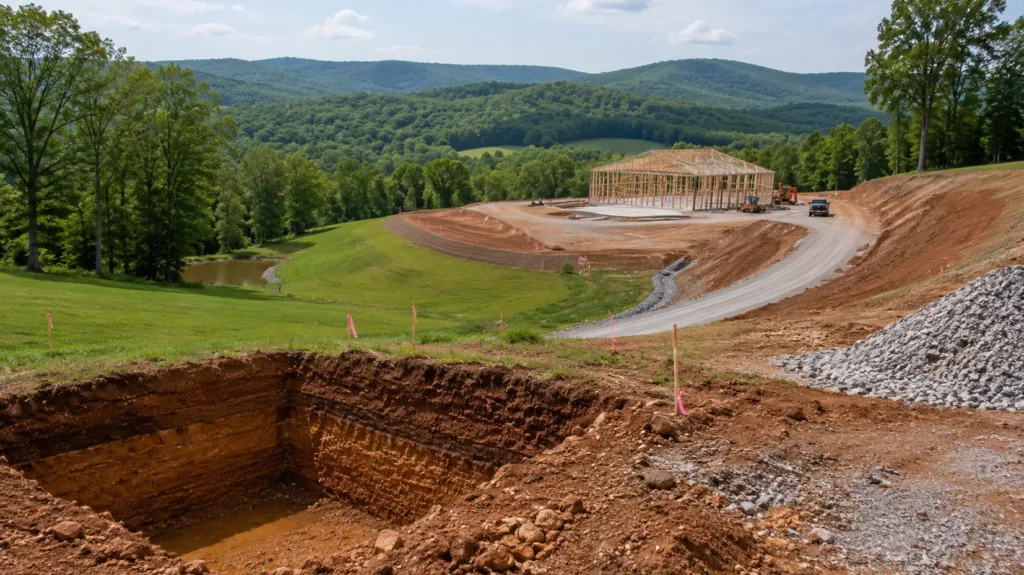
Tennessee’s terrain shifts dramatically across the state, and soil quality has a direct effect on foundation design, drainage, and cost. West Tennessee tends toward flatter land with clay-heavy soil that requires proper compaction. Middle Tennessee often sits over limestone, which can affect excavation depth. East Tennessee’s sloped terrain across the Cumberland Plateau and surrounding hills demands more careful grading to protect long-term structural stability.
A site evaluation before purchase should look at:
- Soil composition, including clay content, rock, and karst or sinkhole-prone conditions
- Slope and grading needs for a level building pad
- Natural drainage paths and flood-prone low areas
- Tree cover and clearing requirements
- Creek crossings or wetland areas that could restrict where you build
An engineer or experienced site evaluator can flag problems that aren’t visible during a casual walkthrough, particularly rock close to the surface or drainage patterns that only show up during heavy rain. Getting land selection and site evaluation support in Tennessee early in the process helps you compare parcels on their actual buildability rather than appearance alone.
Verify Septic Feasibility With a Perc Test
If the property doesn’t have access to municipal sewer, which describes most rural and semi-rural Tennessee land, a septic system is required, and that system depends entirely on a passed percolation test. A perc test measures how quickly water drains through the soil at the proposed drain field location. Soil that drains too fast can let wastewater reach groundwater before it’s filtered. Soil that drains too slowly, or hits rock or clay close to the surface, can’t support a standard system at all.
Key points to understand about septic feasibility:
- A failed perc test can make an otherwise attractive parcel unbuildable as a primary residence
- Testing should be performed by a licensed soil engineer or a tester approved by the county health department
- Septic system size is based on the number of bedrooms and expected wastewater flow, not square footage
- Sites with poor percolation may still qualify for an alternative system, such as an aerobic treatment unit or a mound system, though these cost more
- Any offer to purchase land should be made contingent on a passed perc test whenever the seller hasn’t already completed one
Skipping this step is one of the most common reasons a barndominium project stalls after the land is already purchased.
Want to talk to a qualified barndo builder in Tennessee?
Confirm Water, Power, and Utility Access
Utility access affects both your budget and your timeline, and it’s easy to underestimate on rural Tennessee land. Before buying, confirm what’s already at the property line versus what needs to be extended.
- Electric: call the local utility or electric cooperative with the parcel address and ask what a new line extension would cost. Long runs across open land can add tens of thousands of dollars
- Water: determine whether public water reaches the site or whether a well is required, and ask neighbors or the county health department about typical well depths in the area
- Septic: budget separately from the perc test itself, since installation costs vary by system type
- Internet and cell service: important if you plan to work from the property, since coverage can be inconsistent in more remote counties
- Road access: confirm the property has legal, maintained access, not just a path across a neighbor’s land
Utility costs are one of the biggest variables between two lots that otherwise look similar, so getting real quotes before closing protects your overall budget.
Understand Building Codes and Local Permitting
Tennessee enforces the 2012 International Building Code and 2018 International Residential Code statewide, but enforcement happens primarily at the local level, which means requirements can look different from one county to the next. Some rural and agricultural areas don’t require a building permit for the structure itself, though permits are almost always required for electrical hookups and septic systems. Urban areas and designated conservation zones tend to enforce stricter rules.
Because permitting environments vary this much, it helps to understand city vs county rules for buildings in Tennessee before you settle on a parcel. A property just outside city limits may have a very different permitting process than one a few miles further out in unincorporated county land.
Regional Differences Across Tennessee
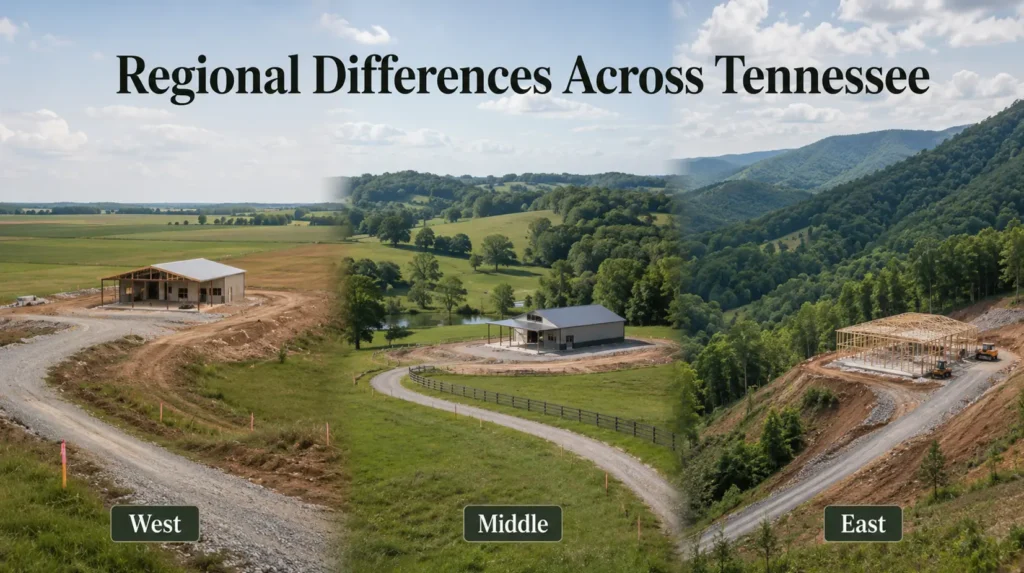
Land conditions and permitting environments shift across the state’s three grand divisions, and it’s worth understanding these differences before narrowing your search.
- West Tennessee: generally flatter land with clay-heavy soil, which needs proper compaction and moisture control before foundation work
- Middle Tennessee: includes limestone in many areas, which can affect excavation depth and septic system positioning, along with fast-growing suburban markets around Franklin and the wider barndominium builders in Middle Tennessee service area
- East Tennessee: sloped terrain across the Cumberland Plateau and mountain areas requires more careful grading and drainage planning
Lake communities, floodplain-adjacent parcels, and mountain view lots each carry their own considerations, from flood zone status to septic limitations tied to steep grades.
Common Mistakes to Avoid When Buying Land
Most problems trace back to skipping due diligence in the rush to secure a property. The most common mistakes include:
- Buying land before confirming zoning allows a barndominium-style structure
- Skipping the perc test or closing before results come back
- Assuming utility access exists without getting a written cost estimate
- Ignoring easements that could restrict access or future construction
- Overlooking flood zone status, especially on land near creeks or in low-lying valleys
- Not getting a professional survey to confirm boundary lines before disputes arise
Working with Tennessee barndominium contractors who understand local counties can help catch these issues before they turn into costly surprises after closing.
We can help you find the right land for your barndominium,
How Land Conditions Shape Your Floor Plan
Once a parcel clears zoning, soil, and septic requirements, the site itself starts to influence design decisions. Slope affects whether a walkout foundation makes sense. Setback distances determine how large a footprint you can build. Utility placement can influence where the driveway, garage bays, or shop space end up. Reviewing Barndominium floor plans in Tennessee alongside your site evaluation, rather than choosing a plan first and fitting it to the land afterward, tends to produce a smoother permitting process and fewer redesigns.
Conclusion
Buying land for a barndominium in Tennessee comes down to confirming a handful of specific things before you close: zoning that allows the structure, soil and perc test results that support a septic system, realistic utility costs, legal road access, and a clear understanding of local permitting requirements. Skipping any one of these steps is the most common reason projects stall after the land is already purchased. Working through this checklist with an experienced local team before you buy gives you a much clearer picture of what a parcel can actually support, and protects your budget and timeline once construction begins.
Frequently Asked Question
Do I need land before I can start designing my barndominium?
Yes, in most cases. Site conditions like slope, setbacks, and utility placement directly affect what can be built and where, so finalizing a floor plan before securing land often leads to redesigns once the site evaluation is complete.
How much does it cost to bring utilities to rural barndominium land?
Costs vary widely. Electric line extensions across open land can run from a few thousand dollars to well over $30,000 depending on distance and terrain, and well drilling can range from around $3,500 to $20,000 or more depending on depth. Getting written quotes before closing is the only reliable way to budget accurately.
Can a homeowner pull their own building permit in Tennessee?
Yes, under specific conditions. A property owner can act as their own contractor if the home is for their personal residence, not for sale or rent, and they have not held a homeowner permit in the previous 24 months. Licensed subcontractors are still required for electrical, plumbing, and mechanical work.
Are barndominiums allowed anywhere in Tennessee?
Most areas allow them, provided the property is properly zoned and the required building permits are obtained. Some rural and agricultural counties have minimal zoning restrictions, while areas closer to major cities tend to enforce stricter residential zoning rules.
What’s the difference between city and county requirements for barndominiums in Tennessee?
Tennessee enforces building codes statewide, but enforcement and permitting happen primarily at the local level. Counties often have more flexible zoning and fewer permit requirements than incorporated cities, where stricter residential zoning and inspection processes are common.