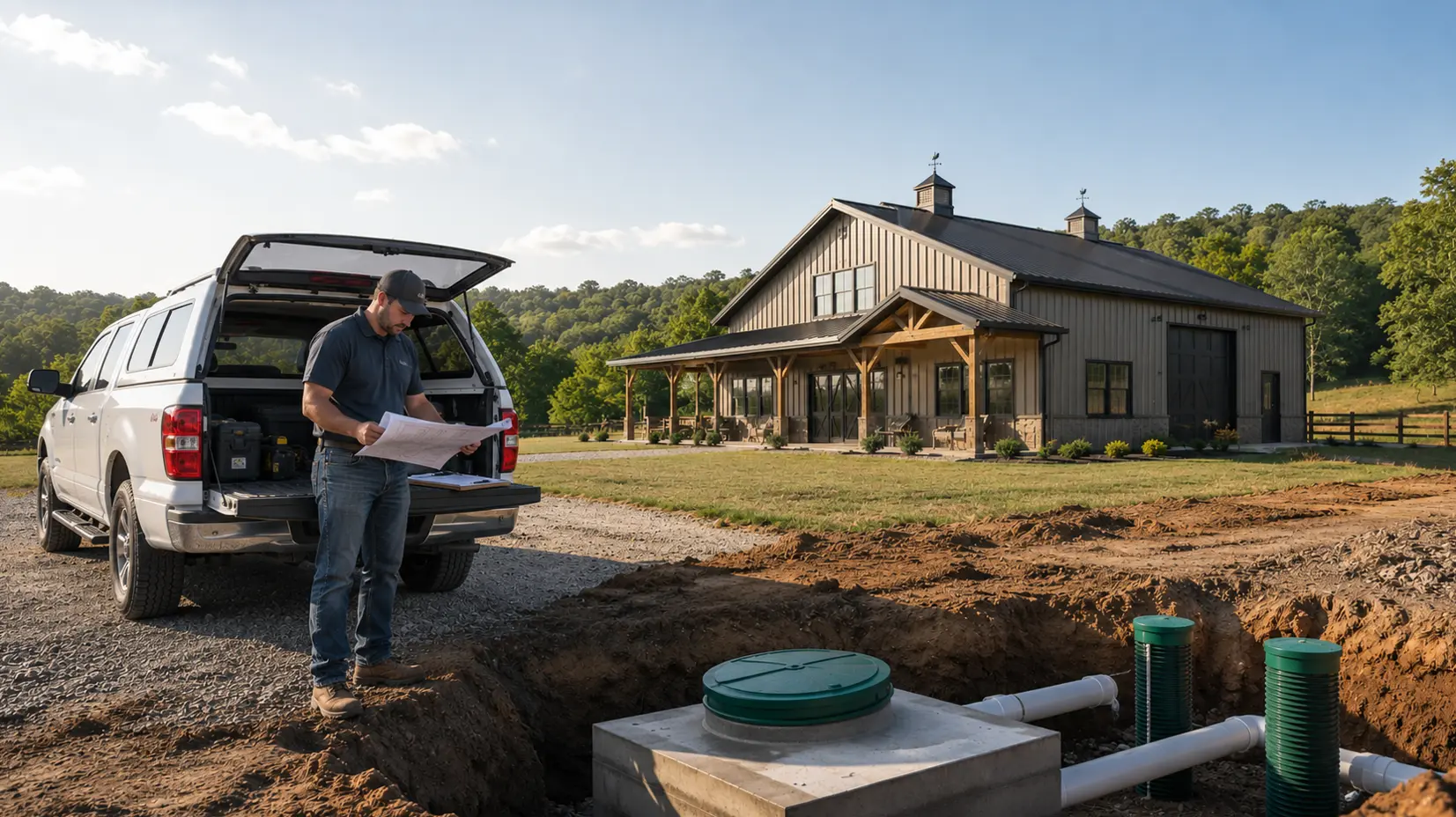
Most rural and semi-rural land in Tennessee has no access to municipal sewer service, which means septic approval is one of the first hurdles any barndominium project has to clear. Before a foundation is poured or a single post is set, the soil on your property has to be tested, mapped, and approved by the state. Skipping or rushing this step is one of the most common reasons ground-up projects stall for weeks. This guide explains exactly what septic approval involves in Tennessee and how it fits into the broader construction timeline.
Why Septic Approval Comes Before Everything Else in Tennessee
Septic approval sits at the very start of the Tennessee construction sequence because it determines whether a piece of land can legally support a home at all. A parcel can have perfect zoning, easy road access, and beautiful views, and still be unbuildable if the soil cannot absorb and filter wastewater properly. That is why septic evaluation typically happens during, or even before, the land purchase itself, alongside land selection in Tennessee, rather than after closing.
The result of the soil evaluation also decides how large a home you can build, since Tennessee ties septic system capacity directly to bedroom count. A property that only supports a two-bedroom system cannot be permitted for a four-bedroom barndominium, no matter how large the structure itself is. This is a detail many first-time land buyers miss until it is too late to change course affordably.
How TDEC and County Health Departments Split the Approval Process
Septic regulation in Tennessee works on two levels. The Tennessee Department of Environment and Conservation, or TDEC, sets the statewide rules for how septic systems are designed, sized, and installed under the state’s onsite sewage program. Day-to-day administration, however, happens locally. Each county’s environmental health office, operating under the Tennessee Department of Health, receives applications, reviews soil evaluations, and issues the actual construction permit for that county.
This two-tier structure means the paperwork process looks similar everywhere in Tennessee, but the pace and the local nuances differ from one county to the next. A soil evaluator familiar with the terrain around Knoxville may work with rocky, sloped ground, while a property near Nashville or in the flatter stretches of Middle Tennessee often deals with heavier clay soils instead.

The Soil Evaluation and Percolation Test, Explained
The soil evaluation is the technical heart of septic approval. A licensed soil scientist or evaluator visits the property, digs test pits, and studies the soil’s texture, depth, structure, and drainage characteristics across the area proposed for the drain field. This is where the term “percolation test,” or perc test, comes from. It measures how quickly water moves through the soil, which tells the state whether the ground can filter wastewater safely before it reaches groundwater.
Under Tennessee’s onsite sewage rules, a formal percolation test is required whenever the soil’s estimated absorption rate is slow enough to fall into a specific regulatory range. Faster or clearly favorable soils may only need mapping rather than a full perc test. Either way, the evaluator’s findings determine:
- Whether the site can support a conventional gravity-fed septic system
- How large the drain field needs to be for the proposed number of bedrooms
- Whether an alternative or engineered system is required instead
- Where on the property the system can legally be located, based on setback rules
Because this step shapes so much of what comes after, it is worth having it done before finalizing barndominium floor plans in Tennessee, since bedroom count and layout can shift once the soil report comes back.
Applying for the Septic Construction Permit
Once the soil evaluation is complete and the site is deemed suitable, the next step is submitting a formal application to the county health department for a septic construction permit. The application typically includes the soil report, a site plan showing the proposed house footprint and drain field location, and the number of bedrooms the home will have. The county reviews this package against TDEC’s design standards before issuing the permit.
The permit itself specifies the type of system approved, its capacity, and the required setback distances from wells, property lines, water bodies, and the structure itself. In Tennessee, this permit generally remains valid for three years from the date it is issued, so property owners who delay construction for longer than that may need to reapply and go through a new site evaluation.
Want to discuss Septic Construction Permit with a barndo builder?
How Septic Approval Connects to Your Building and Plumbing Permits
Septic approval does not exist in isolation. It is one link in a chain of permits that has to line up correctly before a barndominium can move from land to a finished, occupiable home. The general sequence looks like this:
- The county health department issues the onsite sewage disposal permit, specifying system type and setbacks
- The local building authority issues the plumbing permit covering interior fixtures and the building sewer line
- An inspector reviews the interior rough plumbing before walls are closed in
- A permitted installer constructs the septic tank and drain field to the approved design
- The building sewer is connected to the septic tank, and both the plumbing inspector and the county environmental health officer sign off before occupancy is approved
Because these approvals depend on each other, a delay in septic permitting can push back the building permit timeline as well. This is one of many reasons the sequencing of approvals is different in Tennessee than in states with more uniform, single-agency permitting, a point covered in more depth in our guide to what makes building a barndominium in Tennessee different from other states.
What Happens If the Soil Fails a Perc Test
A failed perc test is not automatically a dead end, though it does change the project scope. It simply means the soil in that specific test area cannot support a standard gravity-fed septic system, often because it drains too slowly, sits too close to bedrock, or has a seasonally high water table. Since Tennessee’s testing grid evaluates the land in blocks, a failure in one section does not necessarily rule out the entire property.
When a site fails, the usual next steps are to test an alternate area of the property, or to design around the limitation with an engineered system. These come with added upfront cost, but they open up land that would otherwise be unbuildable, which matters a great deal in counties where usable, well-drained acreage is limited.
Septic System Types Used on Tennessee Barndominium Projects
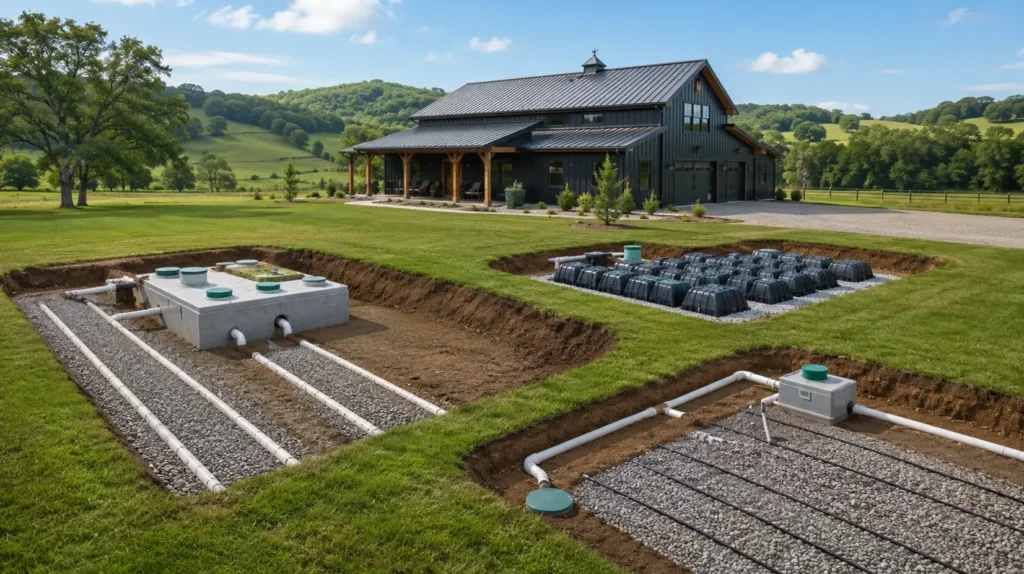
Not every barndominium site ends up with the same kind of system. The soil report and the size of the home determine which option applies:
- Conventional gravity systems, used where soil drainage and slope are favorable
- Aerobic treatment units, which use oxygen to produce cleaner effluent on tighter or more sensitive sites
- Mound systems, which raise the drain field above grade when groundwater or bedrock sits too close to the surface
- Pump-assisted systems, needed when the drain field sits higher than the tank due to the property’s natural grade
Barndominiums add a wrinkle here that traditional homes do not always have, since many combine living space with an attached workshop, garage, or barn area that can affect water usage and system sizing. Builders who handle design and septic coordination in-house, rather than treating it as a separate contractor’s problem, tend to catch these sizing issues before they become expensive change orders.
How Long Septic Approval Takes in Tennessee
Timelines vary by county, but property owners should generally expect the process from initial soil evaluation to a signed construction permit to take somewhere between three and eight weeks. Several factors influence where a given project lands within that range:
- How quickly the county health office can schedule the site visit
- Whether the soil evaluation reveals a straightforward site or one needing further testing
- Whether the proposed design needs revisions before it meets TDEC standards
- The current workload and staffing at the local county office
Because this timeline can shift the overall construction schedule, most experienced Tennessee barndominium contractors recommend starting the soil evaluation as early as possible, ideally before finalizing other design decisions that depend on the outcome.
Regional Differences Across Tennessee Counties
Septic approval follows the same state framework everywhere in Tennessee, but local conditions still shape how a project unfolds. Soil composition, terrain, and even the pace of the county health office can differ noticeably between regions. A site near Franklin may sit on well-drained soil that clears evaluation quickly, while land elsewhere in the state might require additional testing due to rock outcroppings or high water tables.
These differences are one reason building rules in Tennessee are not applied identically from one place to the next. For a closer look at how jurisdiction affects a project beyond septic approval alone, see our guide on city vs county rules for buildings in Tennessee. Builders working across Middle Tennessee and beyond often develop working knowledge of which counties tend to move faster and which typically require more lead time.
Want to discuss septic approval in your region in Tennessee
Common Mistakes That Delay Septic Approval
Most septic-related delays on barndominium projects trace back to a handful of avoidable mistakes:
- Finalizing house plans and bedroom count before the soil evaluation results are back
- Assuming a neighboring property’s septic approval guarantees the same outcome next door
- Waiting until after closing on land to schedule the soil evaluation
- Overlooking setback requirements from wells, property lines, or water features
- Letting a construction permit lapse past its three-year validity window before building begins
Avoiding these pitfalls usually comes down to sequencing the project correctly from the start, which is easier to manage when land evaluation, design, and construction are coordinated by the same team rather than handled by several separate parties working independently.
Conclusion
Septic approval is not a formality to work around once construction starts. It is a foundational step that determines whether land is buildable, how large a home it can support, and how the rest of the permitting process will unfold. Property owners who treat soil evaluation as an early priority, rather than an afterthought, avoid the most common causes of delay on Tennessee barndominium projects. Understanding this process before shopping for land puts you in a far stronger position once you are ready to start planning your build.
Frequently Asked Question
Do I need a septic permit for every barndominium in Tennessee?
Yes. Tennessee state law requires a septic permit for all new onsite sewage systems, with no exceptions for rural properties, small systems, or owner-occupied homes. This applies whether the structure is a traditional house or a barndominium.
How long does septic approval take in Tennessee?
Most property owners can expect the process to take roughly three to eight weeks from the initial soil evaluation to a signed construction permit. The exact timeline depends on the county’s workload and whether the soil report requires additional testing.
What happens if my land fails a perc test?
A failed perc test in one area does not necessarily rule out the whole property, since Tennessee tests land in defined blocks. Owners can often test an alternate location or move forward with an engineered system, such as a mound or aerobic treatment unit, designed to work around the limitation.
Does septic approval limit how many bedrooms my barndominium can have?
Yes. The septic permit specifies the number of bedrooms the system was designed and approved for, and Tennessee law prohibits marketing or building beyond that approved count. This is why bedroom count should be confirmed with the soil report before finalizing house plans.
How long is a septic construction permit valid in Tennessee?
A Tennessee septic construction permit is generally valid for three years from its issue date. If installation is not completed within that window, the permit expires and the property owner typically needs to reapply and undergo a new site evaluation.