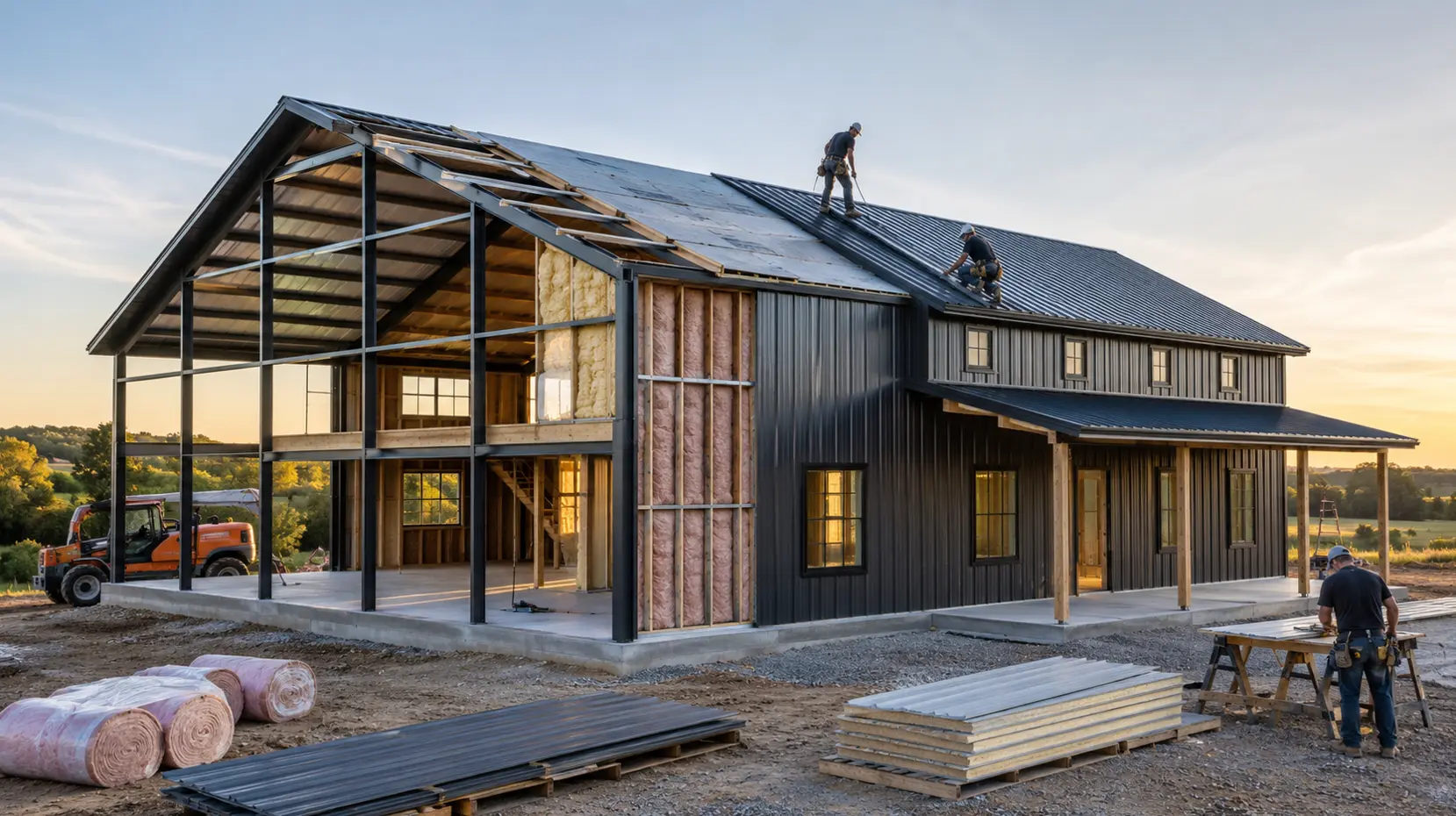
A barndominium in Tennessee typically costs between $185 and $210 per square foot to build as a finished, move-in ready home. That single figure hides a lot. Two builds of the same size on the same road can differ by $80,000 once rock excavation, septic, seismic engineering, and finish level are accounted for.
This guide breaks down what a barndominium costs in Tennessee in 2026: price per square foot by build stage, total cost by size, what land and site work add, and how costs shift between East, Middle, and West Tennessee. Every figure reflects real Tennessee conditions rather than national averages.
Barndominium Costs in Tennessee at a Glance
Cost per square foot only means something once you know what it covers. Tennessee pricing separates out like this:
- Shell to basic interior finish: $130 to $150 per sq ft
- Finished living space: $185 to $210 per sq ft
- Shop and garage space: $55 to $65 per sq ft
- Covered porches: around $35 per sq ft
Most people building a full-time residence land in the $185 to $210 range for living space. None of these figures include land, and site work is quoted separately because it varies so heavily by parcel.
Tennessee Barndominium Cost by Size
The table below shows realistic total construction costs for finished builds, excluding land and major site work.
| Living Space Size | Shell to Basic Finish | Finished Living Space |
|---|---|---|
| 1,000 sq ft | $130,000 – $150,000 | $185,000 – $210,000 |
| 1,500 sq ft | $195,000 – $225,000 | $278,000 – $315,000 |
| 2,000 sq ft | $260,000 – $300,000 | $370,000 – $420,000 |
| 2,500 sq ft | $325,000 – $375,000 | $463,000 – $525,000 |
| 3,000 sq ft | $390,000 – $450,000 | $555,000 – $630,000 |
| 4,000 sq ft | $520,000 – $600,000 | $740,000 – $840,000 |
Cost does not scale in a straight line. Fixed elements like the kitchen, mechanical systems, and roof structure spread across a larger footprint, so the rate per square foot improves as the building grows. That effect is strongest when the added space is shop or porch rather than finished living area.
Please note, the prices mentioned above are average, every situation is unique. For more accurate estimate, please contact our Tennessee team.
Need a barndominium quote tailored to your situation?
What a Turnkey Barndominium Price Actually Includes
Most confusion about barndominium pricing comes from comparing quotes that cover different things. Three terms matter here.
- Kit: the steel or post-frame package delivered to your site. Materials only, no labor, no slab
- Shell or dried-in: slab poured, frame erected, roof and exterior walls closed in. No interior at all
- Turnkey: a finished home with electrical, plumbing, HVAC, insulation, interior walls, flooring, fixtures, inspections, and a certificate of occupancy
The gap between a shell and a finished home is roughly two thirds of the total budget. Turnkey barndominium builders in Tennessee quote the entire scope under one contract, which is why their number looks high next to a shell price that leaves you to source and manage every trade yourself.
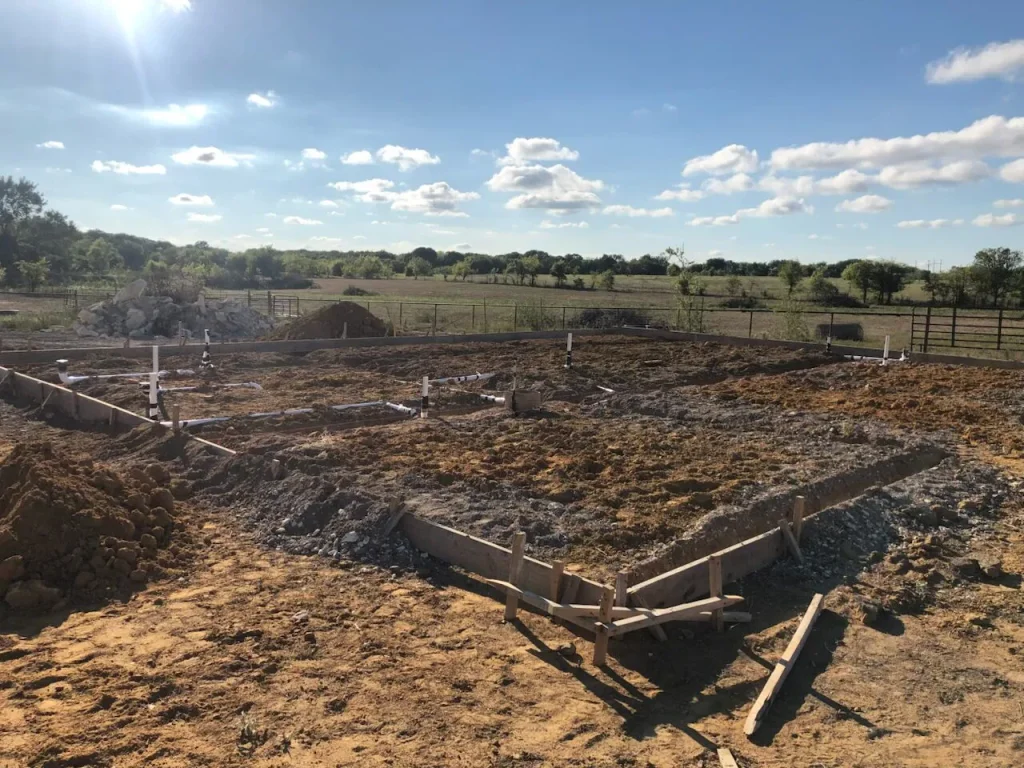
Land and Site Preparation Costs in Tennessee
Site work is where budgets go wrong most often. Before a slab is poured, budget $30,000 to $100,000:
- Rural land: USDA valued Tennessee farm real estate at $5,710 per acre in 2024, and recreational tracts commonly run $4,500 to $10,000 per acre. Land near Nashville is a different market entirely, with Williamson County parcels reaching six figures per acre
- Percolation test: $750 to $1,850 typical, from around $300 on simple sites and past $3,000 where deep excavation is needed
- Septic permit: $200 to $500
- Conventional septic system: $8,000 to $20,000
- Engineered septic system (failed perc): $15,000 to $35,000+
- Water well: Tennessee averages around $8,880 for a complete system at a typical 222 foot depth, with drilling at $28 to $58 per foot
- Clearing, grading, and driveway: $10,000 to $40,000
A failed perc test can make a parcel unbuildable, so getting land selection and site evaluation support in Tennessee before closing costs far less than discovering the problem afterwards. A septic contingency clause in the purchase contract is the standard protection.
Septic approval in Tennessee also sets the start date for everything else, since nothing can be excavated until the system is permitted.
Foundation Costs and Tennessee Soil Conditions
Foundation pricing in Tennessee is driven by geology more than design. A slab-on-grade runs $10 to $20 per square foot, with soil testing and structural engineering adding $2,000 to $5,000.
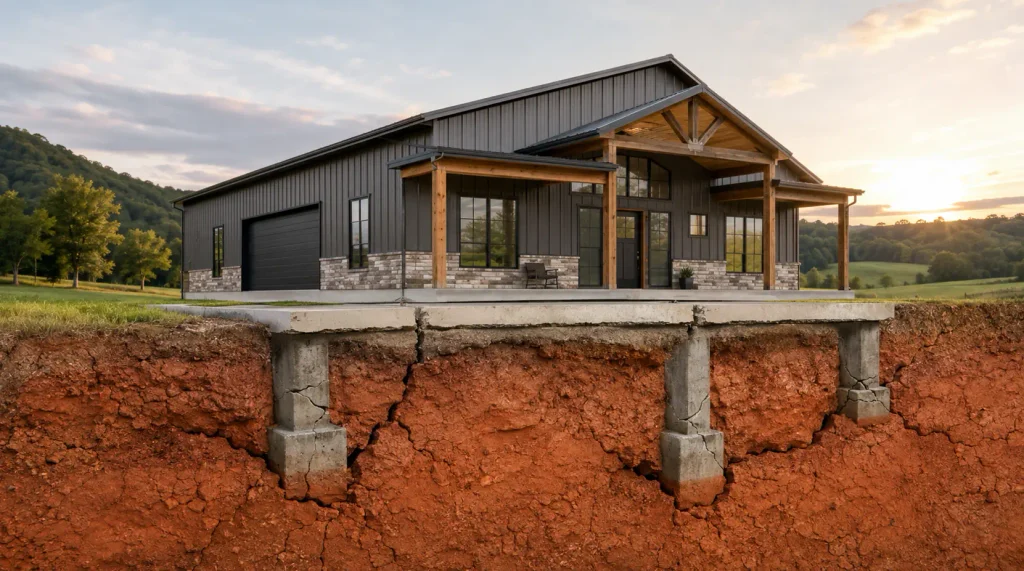
The complication is that Tennessee has three very different subsurfaces. Middle Tennessee sits on limestone and karst, where shallow bedrock can force rock excavation. West Tennessee has clay-heavy and alluvial soils that shift with moisture. East Tennessee combines rocky ridge and valley terrain with slopes that require cut and fill before anything else happens. Anyone pricing a foundation here should understand how Tennessee clay, limestone, and slope affect barndominium foundations before settling on a design.
West Tennessee carries one additional requirement that no other part of the state does. The region falls inside the New Madrid Seismic Zone, which typically places buildings in Seismic Design Category C or D under the Tennessee Residential Code. That means an engineered foundation, reinforced footings, and stamped connection details. Shelby County requires new construction over 400 square feet to demonstrate seismic compliance. Working with barndominium builders in West Tennessee who have carried projects through that review avoids the expensive mistake of buying a generic agricultural kit that was never engineered for residential seismic loads.
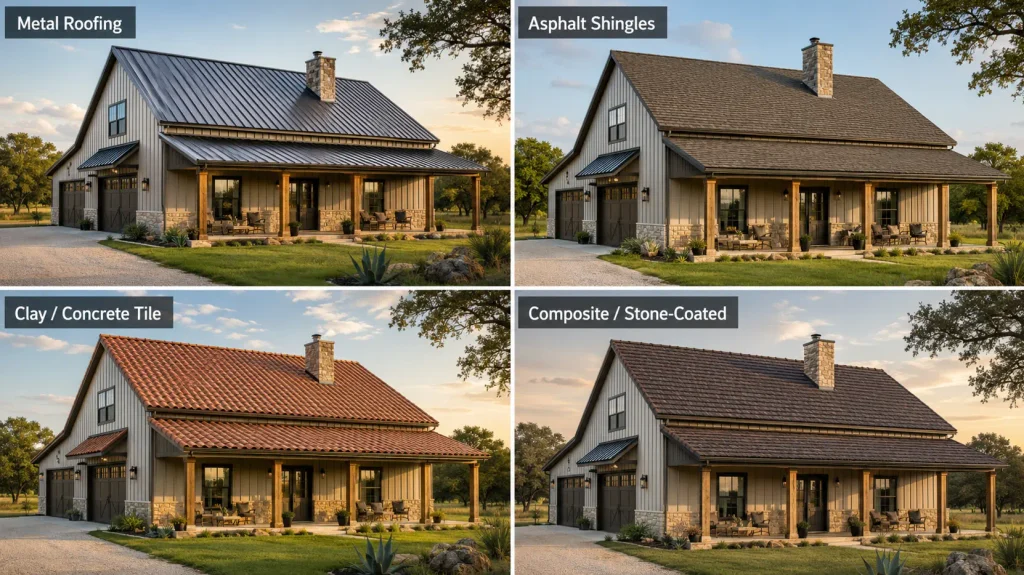
Shell, Roofing, and Exterior Costs
The shell covers the frame, roof system, exterior walls, and openings. Tennessee helps here, because design wind speeds across most of the state sit around 115 mph, which is low by national standards and keeps structural requirements modest.
- Standard metal roofing: $8 to $15 per sq ft
- Standing seam metal roof: $15 to $25 per sq ft
- Standard windows: $300 to $800 each
- Large or custom windows: $1,000 to $3,000+ each
- Exterior doors: $500 to $2,500 each
Roofline complexity is one of the few design decisions with an immediate, measurable cost. A simple gable is far cheaper to frame, sheet, and flash than a roof with multiple valleys and dormers.
Learn about the difference between shell land a turnkey build in Tennessee.
Plumbing, Electrical, and HVAC Costs
Mechanical systems are consistently underestimated because they are invisible on a plan.
- Electrical: $8 to $15 per sq ft
- Plumbing: $5 to $10 per sq ft
- HVAC: $7,000 to $15,000 standard, up to $30,000 for zoned systems
- Spray foam insulation: $2 to $5 per sq ft
Insulation deserves real attention in a Tennessee barndominium. Most of the state sits in Climate Zone 4A, with the Memphis area in the warmer 3A, so you are heating through cold snaps and cooling through humid summers in the same year. Tall open volumes are unforgiving of weak envelopes, which is why closed-cell spray foam is common here.
Are you looking for a barndominium estimate for Tennessee?
Interior Finish Costs
Interior finish is the largest variable, and the gap between the $130 basic rate and the $210 top rate sits almost entirely here.
Flooring per square foot
- Polished concrete: $5 to $10
- Luxury vinyl plank: $4 to $8
- Tile: $8 to $20
- Hardwood: $12 to $25
Kitchens
- Basic: $10,000 to $20,000
- Mid-range: $20,000 to $40,000
- High-end: $40,000 to $80,000+
Bathrooms, per room
- Basic: $5,000 to $10,000
- Custom: $15,000 to $30,000+
Vaulted ceilings and open spans are why people choose barndominiums, but they raise finish costs. Taller walls mean more drywall, more paint, pricier lighting, and more conditioned volume for the HVAC to handle.
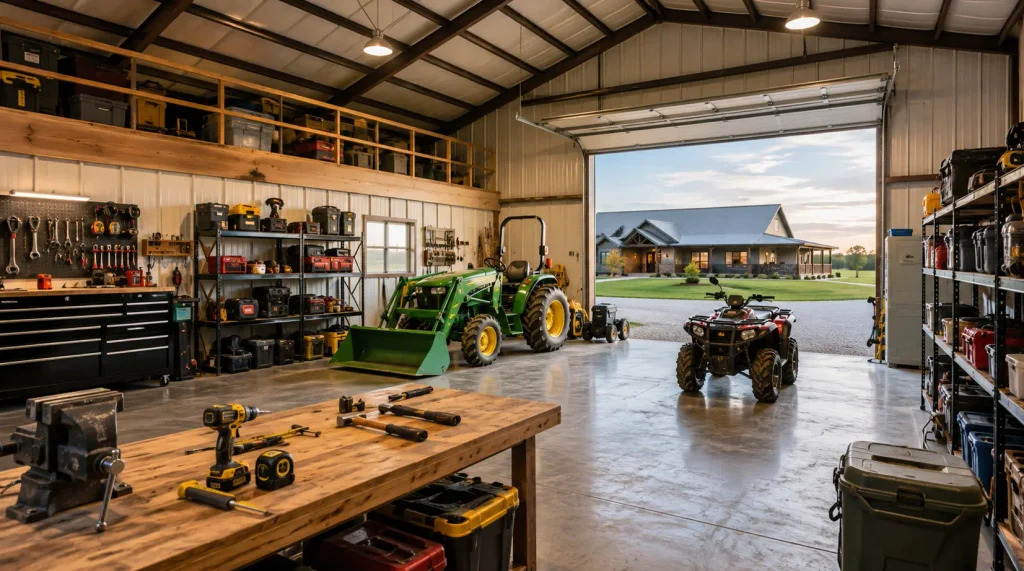
How Shop Space Changes the Cost Per Square Foot
A shop, garage, or RV bay is the cheapest square footage in the building, because it needs no drywall, no flooring, and often minimal conditioning.
- Finished living space: $185 to $210 per sq ft
- Shop and garage space: $55 to $65 per sq ft
- Covered porches: around $35 per sq ft
Barndominium builders in Tennessee quote living space and shop space at separate rates for exactly this reason. A worked example shows why. Take a 2,000 sq ft living area at $195, a 1,000 sq ft shop at $60, and a 400 sq ft porch at $35: $464,000 for a 3,400 sq ft building. The blended rate is roughly $136 per sq ft, well under the living-space rate, even though the contract total is higher. This is why a quoted cost per square foot means little without knowing how much of the footprint is finished living area.
How Costs Vary Across East, Middle, and West Tennessee
Tennessee’s three Grand Divisions behave like separate construction markets.
- East Tennessee: sloped ridge and valley sites, higher excavation and retaining costs, deeper wells at 100 to 500 feet
- Middle Tennessee: the strongest demand and the highest land prices, particularly in the Nashville growth corridor, plus limestone and karst risk
- West Tennessee: flatter and cheaper land, but seismic engineering and drainage on soils where water sits rather than drains
Middle Tennessee deserves a note on unpredictability. Rock depth can change across a single parcel, so barndominium builders in Middle Tennessee usually price excavation as a contingency rather than a fixed line. Nobody knows what is under the topsoil until the machine hits it.
Permits, Engineering, and Tennessee’s County Opt-Out Rule
Tennessee is unusual. The state adopts the Tennessee Residential Code, based on the 2018 International Residential Code with state amendments, but counties can vote to opt out of it entirely. The State Fire Marshal’s Office maintains the current list of opt-out jurisdictions. Some counties enforce their own local codes instead.
This creates a real budget difference between neighboring counties. Knowing the city vs county rules for buildings in Tennessee before you buy land is the difference between a four-week approval and a four-month one. Typical costs look like this:
- Engineering and stamped plans: $3,000 to $10,000
- Building permits: $500 to $3,000 depending on jurisdiction and valuation
- Electrical permit: required statewide, including in opt-out counties
- Septic permit through TDEC or the county health department: $200 to $500
One misconception costs people badly. Living in an opt-out county does not turn a home into a farm building. A residence is a dwelling, and it must be built and documented as one. Permitting a barndominium as agricultural is how owners end up unable to insure, finance, or sell it later. Barndominium permits and inspections in Tennessee create the paper trail a lender or insurer will eventually ask to see.
Hidden Costs That Push Tennessee Budgets Over
The line items below rarely appear in an initial quote but almost always in the final invoice.
- Driveway, culvert, and access road: $5,000 to $25,000
- Utility connections and long service runs: $5,000 to $30,000
- Termite treatment, required statewide in Tennessee’s 100% termite zone
- Builder’s risk insurance during construction
- Temporary power and water on site
- Landscaping, fencing, and final grading: $5,000 to $30,000
- Interest carried on a construction loan through a 6 to 12 month build
Access is the one that scales worst on mountain and hollow parcels. Barndominium builders in East Tennessee price driveway work separately because a long, steep approach can add $20,000 before a single delivery truck reaches the pad.
Drainage is the other one to check before you buy. Low-lying parcels can need fill, culverts, and engineered grading, and how floodplains and drainage affect barndominium construction in Tennessee also decides whether you carry flood insurance for the life of the home.
Is a Barndominium Cheaper Than a Traditional Home in Tennessee?
Usually yes, but by less than most people expect. A comparable custom stick-built home in the greater Nashville area can run $300 to $500+ per square foot, so the saving is genuine at the structural stage. Cost is only one axis, and a full comparison of barndominiums and traditional homes also weighs durability, build time, and long-term maintenance.
The saving comes from the shell. Clear-span steel or post-frame construction goes up faster and needs fewer interior load-bearing walls. What does not change is the cost of a kitchen, a bathroom, a septic system, or an HVAC unit. Those are the same in either building type. Steel framing, simple rooflines, and access to affordable rural acreage are a large part of what makes building a barndominium in Tennessee different from other states where suburban zoning restricts where these homes can go at all.
Find a full comparison and whether a barndominium is cheaper than a traditional house in Tennessee.
DIY, Contractor-Managed, or Turnkey: How Build Method Affects Cost
How you run the project changes the price as much as what you build.
- Owner-builder or partial DIY: lowest headline rate, highest risk and time cost
- Contractor-managed build: you still coordinate trades and carry the gaps
- Full turnkey build: $185 to $210 per sq ft, fixed scope under one contract
The owner-builder route looks like a substantial saving on paper. In practice it moves risk onto you: scheduling gaps, material escalation, failed inspections, and no single warranty. Tennessee barndominium contractors absorb that risk inside a fixed-price contract, which is also what most construction lenders want to see before releasing draws.
Conclusion: Budgeting Your Tennessee Barndominium
For a realistic 2026 plan, budget $185 to $210 per square foot of finished living space, then add site work on top rather than hoping it fits inside the build number. A typical 2,000 square foot turnkey project lands between $370,000 and $420,000 before land and before septic, well, and driveway costs.
The decisions that move your final number most happen early: which parcel you buy, whether it percs, what sits under the topsoil, how complex the roofline is, and how much of the footprint is shop rather than living space. Get those right and the rest of the budget behaves predictably.
Frequently Asked Question
How much does it cost to build a barndominium in Tennessee per square foot?
Most finished barndominiums in Tennessee cost $150 to $185 per square foot in 2026. An erected shell with no interior runs $50 to $80 per square foot, while high-end custom builds can exceed $250. These figures exclude land and site preparation.
Is it cheaper to build a barndominium or a traditional house in Tennessee?
A barndominium is generally cheaper, mainly because the shell goes up faster and needs fewer load-bearing walls. The saving narrows once you finish the interior, since kitchens, bathrooms, septic, and HVAC cost the same in either build. Expect a meaningful difference rather than a dramatic one.
How long does it take to build a barndominium in Tennessee?
Most projects run 6 to 12 months from design to move-in. Design and engineering take 2 to 4 weeks, kit fabrication 6 to 10 weeks, shell erection 2 to 4 weeks, and interior finishing 3 to 5 months. Permitting delays and winter weather are the usual causes of overrun.
Can you get a construction loan for a barndominium in Tennessee?
Yes. Construction-to-permanent loans are the standard route, and USDA Rural Development loans cover much of rural Tennessee. The common sticking point is appraisal, so use a lender and an appraiser who have handled barndominiums before, or the home may be valued as a metal building rather than a residence.
Do you need a permit to build a barndominium in Tennessee?
It depends on your county. Many rural counties have opted out of the state residential code, but electrical and septic permits still apply everywhere. Even in opt-out counties, a home used as a residence must be built to residential standards if you want it to be insurable, financeable, and sellable.